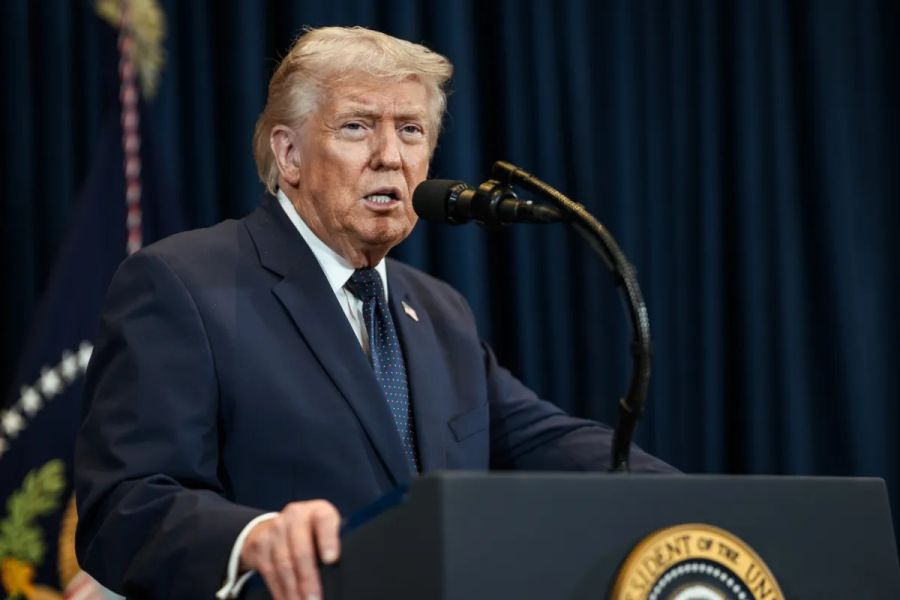
Washington- President Donald Trump over the course of a day went from threatening Iran with "annihilation" to proclaiming that the battered Islamic Republic's leadership had presented a "workable" plan that led him to agree to a 14-day ceasefire that he expects to pave the way to end the nearly six-week-old war.
The dramatic shift in tenor came as intermediaries, led by Pakistan, worked feverishly to head off a further escalation of the conflict. Even China -- Iran's biggest trading partner and the United States' most significant economic competitor -- quietly pulled strings to find a pathway toward a ceasefire, according to two officials briefed on the matter who were not authorized to comment publicly and spoke on the condition of anonymity.
"The reason for doing so is that we have already met and exceeded all Military objectives, and are very far along with a definitive Agreement concerning Longterm PEACE with Iran and PEACE in the Middle East," Trump declared in a social media post announcing the temporary ceasefire, about 90 minutes before his deadline for Tehran to open the critical Strait of Hormuz or see its power plants and other critical infrastructure obliterated.
As the deadline neared, Democratic lawmakers decried Trump's threat to wipe away an entire civilization as "a moral failure", and Pope Leo XIV warned strikes against civilian infrastructure would violate international law, calling the president's comments "truly unacceptable".
But in the end, Trump may have ultimately backed down because of a simple truth: Escalation could risk involving the United States in the sort of "forever war" that had bedevilled his predecessors and that he had vowed he'd keep the United States out of if voters sent him back to the White House.
Controlling the strait would have been a long, costly operation
As Trump boasted about U.S. and Israeli military success over the last six weeks, he appeared to be working from the premise that he could bomb Iran into capitulation.
Starting with the assassination of Ayatollah Ali Khamenei in the opening salvos of the war, he seemed to discount that the Iranian leadership could opt for a long, bloody war.
The Islamic Republic, over the last 47 years, has repeatedly shown it's willing to dig in, even when it appears to America they're working against their own self-interest.
The Iranian revolutionary students held Americans hostages for 444 days, from late 1979 to early 1981 in Tehran. Iranians refused to give in to invading forces of the then US backed Saddam Hussein for eight long years, resulting in the death of hundreds of thousands. It stood by Gaza after the Oct. 7 war as well as Hezbollah in Lebanon and fought alongside the Syrian army to keep Bashar al-Assad's government in power in order to retain a supply link for its Lebanese ally.
Iran's leadership - battered and outgunned - exuded confidence that it could very well bog down the world's superpower in a costly, extended conflict even if it might not defeat its mighty air force.
Western Defence analysts largely agreed that the US military could quickly take control of the Strait of Hormuz, the narrow Persian Gulf waterway between Iran and Oman through which roughly 20% of the world's oil flows on any given day. But maintaining security over the waterway would require a high-risk, resource-intensive operation that could be a years-long American commitment.
Ben Connable, executive director of the nonprofit Battle Research Group, said securing the strait would require the US military to maintain control of about 600 kilometres (373 miles) of Iranian territory, from Kish Island in the West to Bandar Abbas in the East, to stop Iran from firing missiles at ships passing through the strait. It's a mission that Connable said would likely require three U.S. infantry divisions, roughly 30,000 to 45,000 troops.
"This would be an indefinite operation -- so, you know, think be ready to do this for 20 years," said Connable, a retired Marine Corps intelligence officer. "We didn't think we were going to be in Afghanistan for 20 years. We didn't think we're going to have to be in Vietnam as long as we were, or Iraq."
The two-week ceasefire plan includes allowing both Iran and Oman to charge fees on ships transiting through Hormuz, a regional official said. The official said Iran would use the money it raised for reconstruction.
The strait is in the territorial waters of both Oman and Iran. The world had considered the passage an international waterway and never paid tolls before.
Sen. Chris Murphy, D-Conn., said after the ceasefire was announced that Trump was effectively giving Tehran "control" of the strait and delivering "a history-changing win for Iran".
"The level of incompetence is both stunning and heartbreaking," Murphy said.
Trump has a pattern of backing down from maximalist demands
The ceasefire announcement came after Pakistan's Prime Minister Shehbaz Sharif urged Trump to extend his deadline by two weeks to allow diplomacy to advance while also asking Iran to open the strait for two weeks.
Two weeks has become Trump's favourite interval to buy himself time when making major decisions. Last summer, the White House said he'd decide about launching an initial bombing campaign against Iran within two weeks -- only to have the president order airstrikes that he said "obliterated" Iran's nuclear program before that interval was up.
Trump has also repeatedly used two weeks to set deadlines that ultimately led to very little during negotiations to end Russia's war with Ukraine, even going back to his first term, suggesting he'd have major policy issues like health care solved over such a timeframe.
Trump has repeatedly made maximalist demands throughout the first 15 months of his second White House term only to dial them back.
The president backed off many of the sweeping "Liberation Day" tariffs he first announced in April 2025 after they caused the financial markets to go haywire. Perhaps the most spectacular example came during a January meeting of the World Economic Forum in Davos, where Trump insisted that he wanted the U.S. to take control of Greenland "including right, title and ownership" only to switch course and abandon his threat to impose widespread tariffs on Europe to press his case.
The pretext for backing down that time was Trump saying he'd agreed with the head of NATO on a "framework of a future deal" on Arctic security -- even though the U.S. already enjoyed widespread military latitude in Greenland, which is part of the kingdom of Denmark. (AP)
Conversations
The opinions expressed in reader contributions are those of the respective author only, and do not reflect the opinions/views of Trans Asia News.