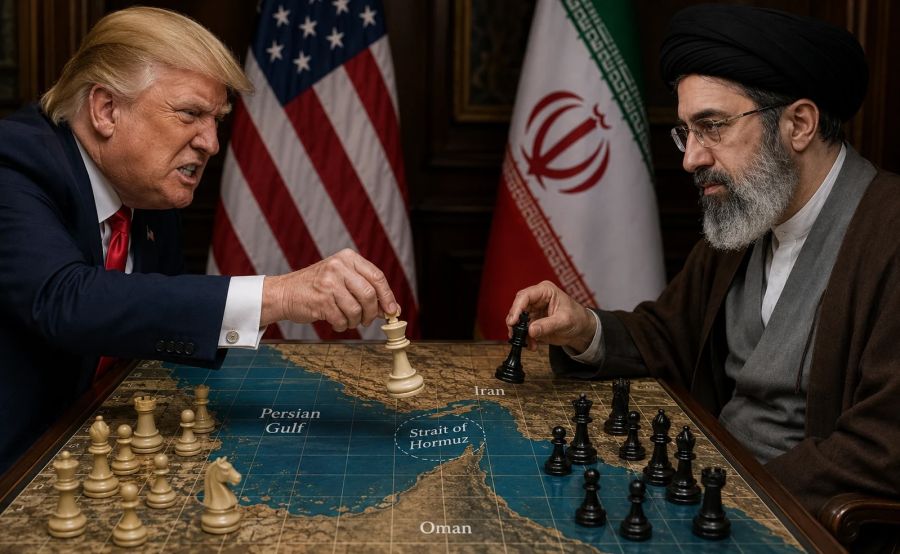
London - A prominent U.S. foreign policy strategist who long championed American military intervention abroad has warned that Washington may have suffered a major strategic defeat in its conflict with Iran, as Tehran on Tuesday declared a dramatic expansion of its operational control over the Strait of Hormuz and vowed to confront any perceived violation of its territorial waters.
The warning from Robert Kagan, one of the most influential advocates of American interventionism since the Iraq war era, came in a widely discussed essay published by The Atlantic on May 10 titled 'Checkmate in Iran', in which he argued that the United States had entered a strategic trap from which there was no clear exit.
In the article, Kagan offered a bleak assessment of the war launched against Iran on February 28, writing that "the US suffered a total defeat" -- one that he said had "no precedent in American history" and could "neither be repaired nor ignored".
Kagan wrote that despite a 37-day US-Israeli air campaign that killed senior Iranian leaders and military figures while heavily damaging parts of Iran's military infrastructure, Tehran had neither capitulated nor collapsed.
Instead, Iran had transformed the Strait of Hormuz, the world's most critical oil chokepoint, into a source of strategic leverage, while exposing what Kagan described as growing limits to American military power and credibility.
"Far from demonstrating American prowess", Kagan wrote, the conflict had revealed "an America that is unreliable and incapable of finishing what it started."
While acknowledging previous US military failures in Vietnam and Afghanistan, Kagan argued that the Iran conflict represented a fundamentally different kind of geopolitical setback.
"The defeats in Vietnam and Afghanistan were costly but did not do lasting damage to America's overall position in the world," he wrote. "Defeat in the present confrontation with Iran will be of an entirely different character."
The comments have drawn significant attention in Washington because of Kagan's longstanding role within the US foreign policy establishment. A co-founder of the Project for the New American Century and senior fellow at the Brookings Institution, Kagan was among the most prominent intellectual supporters of the 2003 invasion of Iraq and has spent decades advocating assertive US global leadership backed by military force.
The article comes as ceasefire negotiations between Washington and Tehran remain stalled more than two months after war broke out following US and Israeli strikes launched on Feb. 28.
Iranian officials say the Strait of Hormuz remains effectively closed to what they describe as hostile shipping traffic, despite a fragile ceasefire brokered through regional mediation efforts led by Pakistan.
Roughly one-fifth of global oil and gas supplies normally transit through the narrow waterway between Iran and Oman.
In a new development, Iran's Islamic Revolutionary Guards Corps (IRGC) Navy announced on Tuesday that Tehran had fundamentally redefined the operational boundaries of the strait.
"In the past, the Strait of Hormuz was defined as a limited area around islands such as Hormuz and Hengam, but today this has changed," Rear Admiral Mohammad Akbarzadeh, head of the political department of the IRGC, was quoted as saying by Iranian media.
"What Iran considers the operational scope of the Strait of Hormuz has now been significantly expanded," he said, adding that the zone had grown "from a narrow corridor of 20 to 30 miles in the past to a vast strategic area spanning more than 200 to 300 miles -- roughly 500 kilometres -- stretching from Iran's Jask and Sirik to beyond Qeshm and the Greater Tunb Islands. This now forms a complete crescent."
"The Strait of Hormuz is no longer a limited passageway," he added. "It has evolved into a vast operational theatre."
The IRGC said Iran was closely monitoring all regional movements and would not tolerate "any kind of encroachment upon its waters and interests".
It has also warned that vessels operating outside routes designated by Iran could face a "decisive response", according to Iranian state-linked media.
At the heart of Kagan's analysis is the argument that Iran has succeeded in converting military pressure into long-term geopolitical leverage through its control over Hormuz.
"Iran will be able not only to demand tolls for passage but also to limit transit to those nations with which it has good relations," Kagan wrote, arguing that Tehran no longer had any incentive to return to the pre-war regional order.
"The United States will have proved itself a paper tiger, forcing the Gulf and other Arab states to accommodate Iran," he added.
Kagan also rejected suggestions that allied naval coalitions could restore freedom of navigation if Washington failed to do so itself.
"If the United States with its mighty Navy can't or won't open the strait, no coalition of forces with just a fraction of the Americans' capability will be able to, either," he wrote.
Some Iranian officials appear increasingly convinced that time favours Tehran as energy disruptions deepen and Western political pressure intensifies. At the same time, some US security officials continue arguing that additional military pressure could still force concessions from Iran.
Critics of further escalation warn that such assumptions mirror the strategic calculations that preceded the war itself.
Kagan argued that the consequences of the conflict extended far beyond the Gulf region and threatened broader confidence in American global power.
"America's once-dominant position in the Gulf is just the first of many casualties," he wrote. "America's allies in East Asia and Europe must wonder about American staying power in the event of future conflicts."
He also warned that the war had severely strained US military resources.
"Just a few weeks of war with a second-rank power have reduced American weapons stocks to perilously low levels, with no quick remedy in sight," Kagan wrote.
For many observers, the article reflects a broader reassessment within sections of the American foreign policy establishment over the limits of military power in asymmetric conflicts.
"What was meant to produce capitulation has instead produced entrenchment," Kagan concluded.
As ceasefire talks remain deadlocked and shipping through the Strait of Hormuz continues under heightened military tension, diplomats and energy analysts increasingly warn that the crisis could evolve into a prolonged geopolitical confrontation with lasting consequences for the global economy and regional balance of power.
Conversations
The opinions expressed in reader contributions are those of the respective author only, and do not reflect the opinions/views of Trans Asia News.