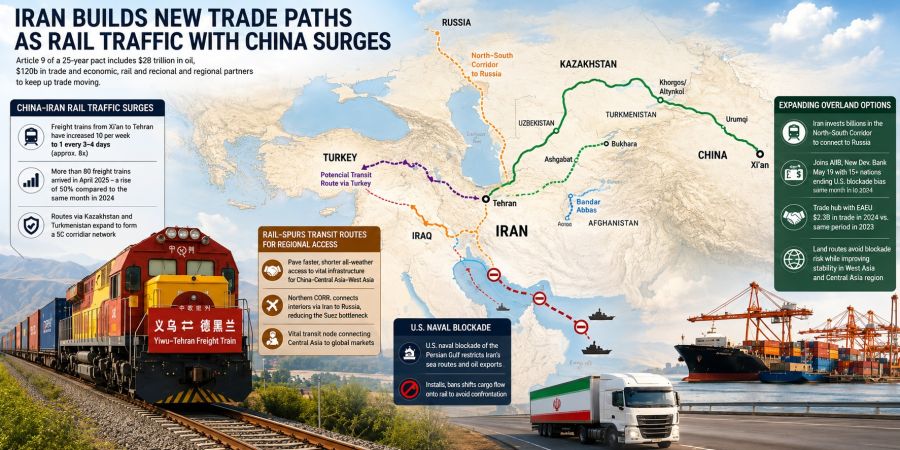
Tehran - Freight train traffic between China and Iran has accelerated sharply since the start of a US naval blockade in the Persian Gulf, underscoring Tehran's widening shift toward overland trade corridors as neighbouring countries move to facilitate Iranian commerce despite Western pressure.
Cargo trains travelling from Xi'an in central China to Tehran have increased from roughly one train per week before the conflict to one every three to four days since the blockade began on April 13, according to a Bloomberg report. The route through Kazakhstan and Turkmenistan has emerged as a critical artery in Tehran's effort to offset maritime disruptions and maintain trade flows.
The increase in rail traffic comes as Iraq issued a direct order to customs authorities across the country requiring the activation of transit and transshipment operations for Iranian goods through Iraqi territory, expanding Tehran's access to alternative trade routes.
Under directives from Iraqi Prime Minister Mohammed Shia al-Sudani's government, customs offices across northern, central, western and southern Iraq, as well as air cargo facilities and Baghdad International Airport, have been instructed to facilitate the transit and reloading of Iranian goods.
The move effectively integrates Iraq's land and air transport infrastructure into Iran's transit network at a time when Tehran faces mounting pressure from a maritime blockade intended to isolate its economy.
The US-led naval restrictions, imposed during the wider regional conflict involving Iran, Israel and allied Gulf states, were designed to inflict economic pressure by constraining Iranian shipping and energy exports. However, rather than cutting Iran off, the measures appear to have accelerated Tehran's transition toward land-based supply chains and regional transport networks.
Iran's strategic geographic position between Asia, the Middle East and Eurasia has enabled it to redirect cargo toward overland corridors connecting China, Central Asia, Afghanistan, Turkey and Russia.
According to data from the Islamic Republic of Iran Railways, more than 40 freight trains from China have entered Iran since the beginning of this year. That compares with just seven trains operating on the route during the previous seven years combined, signalling a dramatic acceleration in rail-based trade.
The China-Iran rail corridor runs through Kazakhstan and Turkmenistan, keeping cargo traffic far from maritime routes vulnerable to naval restrictions. Analysts say direct interference with such land networks could risk broader geopolitical consequences involving Beijing.
The rail expansion forms part of a longer-term strategy pursued by Tehran to reduce exposure to sanctions and external pressure by building logistical partnerships with regional and international allies.
In October, Iran began exporting diesel by rail to Afghanistan through the 225-km Khaf-Herat rail line connecting Iran's northeastern Khorasan Razavi province to Herat.
Earlier, China launched a direct freight rail service to Hairatan in northern Afghanistan, while Uzbekistan and Afghanistan later announced plans to extend rail connectivity to Herat, approximately 130 km from the Iranian border.
Iran has also committed billions of dollars to develop a North-South transportation corridor linking the country with Russia, part of broader efforts to diversify commercial routes.
Kambiz Etemadi, head of the container committee of Iran's national shipping association, said Iran could shift as much as 40% of its conventional maritime trade toward overland transport systems.
On Friday, Iran launched the operational phase of the Sarakhs Economic Zone in Khorasan Razavi province near the Turkmenistan border in another effort to strengthen trade connectivity with China and Central Asia.
The free zone possesses annual cargo handling capacity of 10 million tonnes but currently processes only around 2.8 million tonnes.
Rasoul Rais Jafari, chief executive of the Sarakhs Free Zone Organization, said previous traffic constraints stemmed partly from a lack of return cargo to China. He said exports of zinc and copper concentrates are expected to create return loads that could make rail transportation economically more competitive than maritime shipping.
According to Iranian officials, Sarakhs possesses infrastructure supporting both broad-gauge and standard-gauge railway systems and can process up to 1,000 waggons daily in cooperation with a Chinese logistics company.
The project follows three decades of development and aligns with broader Iran-China cooperation under the two countries' 25-year strategic partnership agreement.
Sarakhs also forms part of the 925-km Kazakhstan-Turkmenistan-Iran railway network inaugurated in 2014 by the leaders of the three countries, with annual freight capacity estimated at between three and five million tonnes.
Turkey is also being considered as a potential alternative trade gateway. Turkish infrastructure already functions as a major logistics platform for imports, manufacturing and transit operations, and Iranian officials have suggested portions of trade traditionally routed through the United Arab Emirates could be redirected there.
Beyond China and Turkey, Tehran has sought to deepen commercial integration with the Eurasian Economic Union (EAEU) through a preferential trade framework under which tariffs on approximately 88% of Iranian commodity groups have been eliminated.
Iranian officials describe the arrangement as giving Tehran an advantage not available to other regional players such as Turkey and China.
Iran currently maintains a trade volume of roughly $25 billion with the UAE, including $15 billion in imports and $10 billion in exports. Officials say a large proportion of imported goods are re-exported products originating elsewhere, creating opportunities to diversify sourcing channels.
Iranian economic studies suggest trade with EAEU member states could increase from approximately $5 billion currently to $15 billion over the next two to three years.
Iranian officials say the expansion of transport and trade corridors demonstrates that efforts to economically isolate the country may instead be strengthening its role as a strategic transit bridge linking East and West.
Analysts say whether these alternative routes can permanently replace maritime commerce remains uncertain, but recent developments suggest Tehran's regional connectivity strategy has gained renewed urgency under geopolitical pressure.
Conversations
The opinions expressed in reader contributions are those of the respective author only, and do not reflect the opinions/views of Trans Asia News.