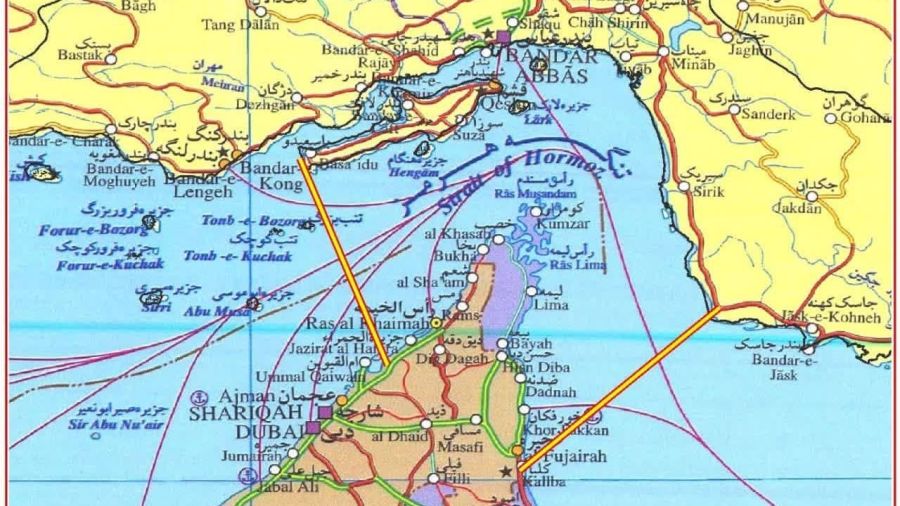
Tehran - Iran has signalled an expansion of its naval reach in the Strait of Hormuz, publishing a map that outlines areas it claims to control across the strategic waterway, in a move that underscores its growing assertiveness amid heightened tensions with the US.
The area begins in the west, along a line between the westernmost tip of Iran's Qeshm Island and the United Arab Emirates' emirate of Umm al-Qaiwain. In the east, the area stops at a line between Iran's Mount Mobarak and the UAE's Emirate of Fujairah.
The development comes as Washington steps up its rhetoric following the latest escalation in the region. US President Donald Trump said the US would "guide" commercial vessels stranded in the Gulf.
Iran responded with a warning that reinforces its claim to authority over the waterway. Ali Abdollahi, head of Iran's Khatam-al-Ambiya unified military command, said all maritime movement must be coordinated with Iranian forces and cautioned that any foreign military presence would face retaliation.
"We have repeatedly said the security of the Strait of Hormuz is in our hands," Abdollahi said, warning that "aggressive" US forces would be targeted if they entered the area.
Hours later Iranian media reported that two missiles struck a US Navy vessel near the Strait after it allegedly ignored warnings from Iranian forces. According to Fars, the warship was operating near Jask port with the intention of transiting the strait without authorisation. The vessel was said to have suffered damage and retreated, though there was no immediate comment from the US military.
Iran has effectively tightened control over shipping flows through the strait since the onset of the conflict, allowing passage largely for its own vessels and those of its allies. The restrictions have disrupted one of the world's most critical energy corridors -- through which roughly a fifth of global oil and gas supplies transit -- contributing to a sharp rise in crude prices and renewed volatility in global markets.
It was not immediately clear if and to what extent Iran's claimed area of control has changed.
Hundreds of commercial vessels and up to 20,000 seafarers have been unable to transit the waterway as a result of the Iran war, the International Maritime Organization said.
Reports said there were no signs of increased vessel traffic through the Strait on Monday, a day after Trump said the country would begin efforts to free up shipping.
No tankers or other commercial vessels were seen lining up to transit, and German shipping group Hapag- Lloyd said transit for its vessels remained impossible due to a lack of clarity over secure passage procedures.
BIMCO: Security situation unchanged
The shipping industry has received no guidance regarding the US operation and its intent, while the overall security situation remained unchanged, the Baltic and International Maritime Council (BIMCO) said.
"Without consent from Iran to let commercial ships transit safely through the Strait of Hormuz, it is currently not clear whether the Iranian threat to ships can be degraded or suppressed," its chief safety and security officer, Jakob Larsen, said. BIMCO provides security alerts for the industry.
The competing signals from Washington and Tehran highlight the risk of further escalation in the Gulf, where control over maritime access has become a central lever of geopolitical power.
Conversations
The opinions expressed in reader contributions are those of the respective author only, and do not reflect the opinions/views of Trans Asia News.