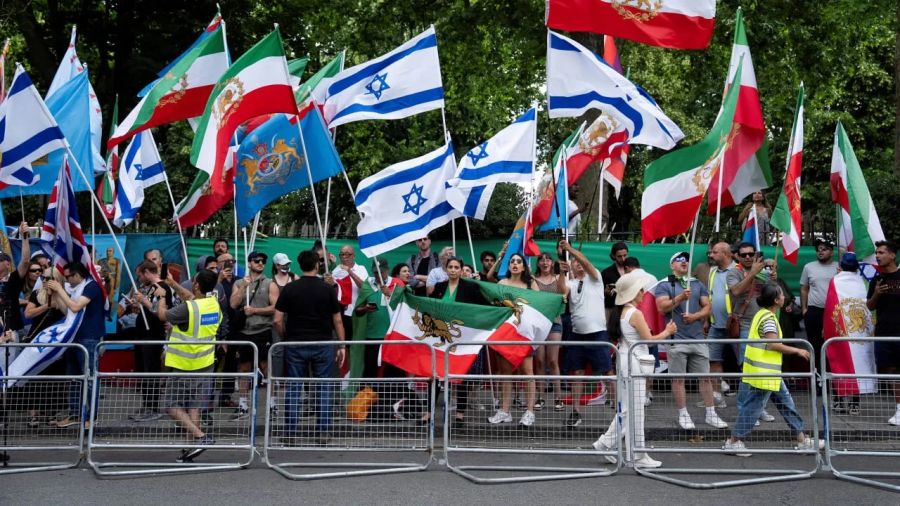
As Tehran faces a growing strategic challenge, tensions between Iran, the United States, and Israel are sharply escalating. The latest standoff is unfolding against the backdrop of a fresh wave of unrest over the past ten days, compounded by the reported abduction of Venezuelan President Nicolas Maduro--an ally of Tehran--by U.S. forces on Saturday, January 3.
On Monday, Iran accused Israel of attempting to undermine its national unity after Prime Minister Benjamin Netanyahu publicly expressed support for the protesters. Speaking at a weekly press conference, Iranian Foreign Ministry spokesperson Esmail Baqaei warned that "the Zionist regime is determined to exploit the slightest opportunity to sow division and undermine our national unity, and we must remain vigilant." He accused both Israeli and U.S. leaders of "incitement to violence."
Middle East expert Robert Inlakesh argues that while the unrest began as a response to genuine economic grievances, it has increasingly been reframed by Tehran as a foreign-backed destabilization effort."What began as a series of genuine protests, stemming from Iranian economic grievances, has now transformed into a fully fledged Israeli intelligence operation that seeks to destabilize Iran," he said. "It is therefore no coincidence that on the day of the Israeli prime minister's departure from the United States, President Trump issued a threat to intervene militarily."
Whether the current unrest eventually fades or escalates--potentially drawing Israel into assassination campaigns alongside a U.S. B-2 bombing operation--it is becoming clear that Tehran and Tel Aviv are on a collision course as 2026 approaches.
Inside Iran, many who initially joined protests purely over economic hardship are now pulling back, as the demonstrations are increasingly perceived to be influenced or overtaken by U.S.- and Israeli-backed elements. Open support from President Trump has reportedly backfired, reinforcing the belief among many Iranians that Washington bears responsibility for the very economic conditions driving the protests.
Much of Iran's economic distress--soaring inflation, a collapsing currency, and shrinking purchasing power--can be traced to U.S. sanctions. During President Barack Obama's tenure, Iran and major world powers reached a comprehensive nuclear agreement designed to ease crippling sanctions in exchange for limits on Iran's nuclear program and strict international monitoring. At the time, there was broad consensus that Tehran was complying with the deal.
Despite this, President Trump withdrew from the agreement during his first term. In its aftermath, Iran was subjected to sweeping and increasingly severe sanctions, which have continued to expand. These measures are widely regarded as a central cause of Iran's ongoing economic crisis and the sharp decline of the rial.
This does not absolve Iran's government of responsibility. Social and economic reforms are clearly needed, as they are in most countries, including the United States. However, many analysts argue that the depth of Iran's current economic crisis would not exist without the sanctions regime. Moreover, sanctions were imposed despite Iran having adhered to the nuclear agreement, making them, in Tehran's view, unjustified.
Seen in this broader context, Iranian officials argue that today's hardships cannot be separated from U.S. policy decisions. This reality, they say, must be considered when assessing the strong Western and Israeli support for the protests.
On January 2, President Trump warned that the United States was "locked and loaded" and prepared to punish Iranian authorities if they attempted to violently suppress demonstrations. Days earlier, Israel's Mossad posted a message in Persian on social media urging Iranians to take to the streets:"Go out together into the streets. The time has come. We are with you. Not only from a distance and verbally. We are with you in the field."As reported by The Hindu on January 3, Iranian officials described the message as incitement rather than simple solidarity.
Viewed alongside years of hostile actions by both Israel and the United States, Tehran contends that their support for the protests is not rooted in concern for the Iranian people, but rather in broader efforts to weaken and destabilize Iran--ultimately seeking to remove the current government and replace it with one more aligned with U.S. and Israeli interests.
Iranian authorities say they are proceeding cautiously. Within existing constraints, they have sought to address legitimate economic grievances while warning citizens not to be misled by actors seeking disruption at the behest of foreign powers. Many Iranians with genuine complaints remain wary of pushing too far, fearing that Western and Israeli involvement could plunge the country into chaos akin to Iraq or Syria.
Ali Larijani, Secretary of Iran's Supreme National Security Council, wrote on social media:"With the statements by Israeli officials and Donald Trump, what has been going on behind the scenes is now clear."He added, "We distinguish between the stance of the protesting shopkeepers and the actions of disruptive actors."
Netanyahu, meanwhile, has framed the protests as a historic turning point. In his first public remarks on the unrest, delivered during a weekly cabinet meeting, he suggested that the demonstrations could mark a decisive moment for Iran's more than 92 million people."The government of Israel, the State of Israel, and my own policies--we identify with the struggle of the Iranian people, with their aspirations for freedom, liberty and justice," he said. "It is quite possible that we are at a moment when the Iranian people are taking their fate into their own hands."
According to Israeli outlet i24 News, Netanyahu later told the Knesset that he and President Trump are in full agreement on Iran, describing their partnership as "a recipe for the continuation of our successes in 2026." His remarks came amid heightened regional tensions over Iran's nuclear and missile programs, which Israel continues to view as existential threats. Netanyahu reiterated a zero-enrichment stance, calling for Iran to export all enriched uranium and submit its nuclear facilities to permanent, intrusive monitoring.
Iran's semi-official Fars news agency reported on Monday that the protests appeared to be losing momentum, noting "a notable decrease in the number of gatherings and their geographic reach compared to previous nights." Independent verification remains difficult, however, as state media have downplayed coverage and many social media videos cannot be authenticated.
Publicly, Iranian officials have struck a conciliatory tone toward economic demands while vowing to act decisively against what they describe as chaos and destabilization. The most intense clashes have been reported in western Iran, though protests and confrontations with police have also occurred in Tehran, central regions, and the southern province of Baluchistan.
The unrest was sparked by Iran's deepening economic crisis. Over the past year, the rial has lost more than a third of its value against the U.S. dollar, while years of double-digit inflation have steadily eroded living standards.
On Sunday, January 4, President Trump again voiced support for Iranian protesters. Speaking aboard Air Force One, he warned:"If they start killing people like they have in the past, I think they're going to get hit very hard by the United States."The statement echoed an earlier post on his Truth Social platform, in which he claimed Washington would directly support peaceful protesters if authorities resorted to violence.
Writing in The Intercept, Iran analyst Seamus Malekafzali argued that Israeli claims of supporting "freedom" for Iranians amount to a coercion campaign aimed at provoking war. While the current demonstrations represent the largest movement since protests following the 2022 death of Mahsa Amini, he noted that they remain relatively limited in scale despite reports of activity in at least 78 cities.
Malekafzali observed that the surge in international attention has come largely from Washington and Tel Aviv, where influential figures have openly hoped that the protests would finally lead to the overthrow of the Islamic Republic. Israeli opposition leader Naftali Bennett released a video--spoken in English and subtitled in Farsi--urging Iranians to rise up, while senior Israeli and U.S. politicians staged symbolic gestures such as wearing "Make Iran Great Again" hats. National Security Minister Itamar Ben-Gvir posted what appeared to be an AI-generated image of Supreme Leader Ali Khamenei crumbling beneath a hangman's noose.
Despite assessments by Israel's own intelligence agencies that the protests do not currently threaten the Iranian state, some U.S. media outlets have embraced narratives suggesting the government's collapse is imminent. Malekafzali also recalled Israel's earlier attempts to incite rebellion during its June war with Iran, when Netanyahu framed military bombardment as a path to Iranian "freedom" and invoked slogans from the Mahsa Amini protests.
During that conflict, the Israel Defense Forces' Farsi-language account even directed Iranians seeking to "improve their situation" to contact the Mossad--advising them to use a VPN.
Although geographically distant, the reported abduction of Venezuelan President Nicolas Maduro has sent what Tehran views as a pointed message, particularly as Trump has personally warned of military intervention if Iranian protesters are killed.
Amid this atmosphere, Iran's Defense Council announced on Tuesday, January 6, that it no longer rules out preemptive strikes against its enemies. "Within the framework of legitimate defense, the Islamic Republic of Iran is not confined to reaction after the action," the statement said, explicitly citing the United States and Israel as sources of escalating threats.
At the same time, Iran's army pledged to defend the country's "national interests" as protests continued amid widespread arrests and an internet blackout. In a statement published by semi-official outlets, the military accused Israel and "hostile terrorist groups" of seeking to undermine public security, vowing to protect strategic infrastructure and public property.
Iran's elite Islamic Revolutionary Guard Corps echoed that warning, declaring that safeguarding national security and the achievements of the 1979 revolution remains a "red line."
As unrest persists and rhetoric hardens, Iran's internal crisis is increasingly entangled with a broader geopolitical struggle--one in which economic grievances on the streets risk becoming the spark for a far more dangerous regional confrontation.
Conversations
The opinions expressed in reader contributions are those of the respective author only, and do not reflect the opinions/views of Trans Asia News.