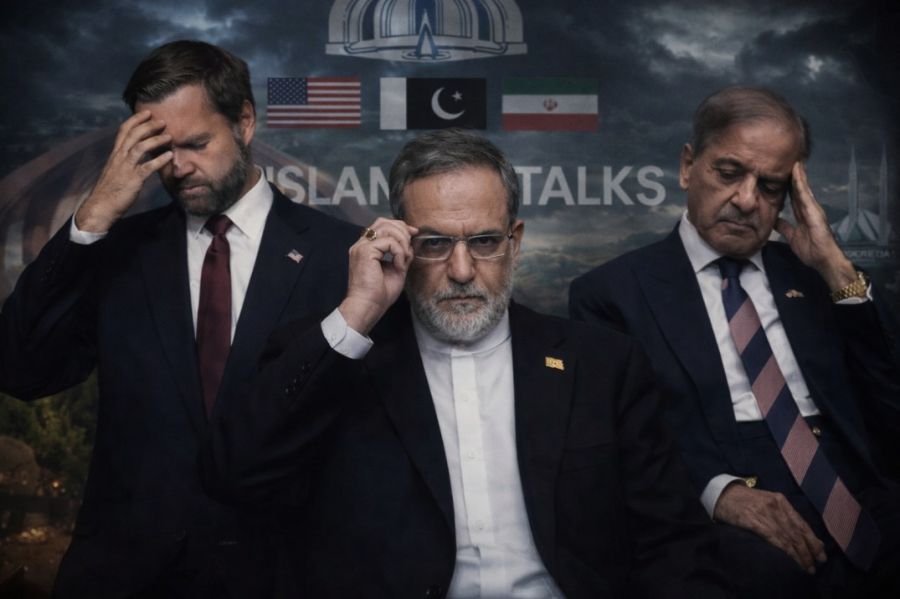
Islamabad : High-stakes negotiations between Iran and the United States collapsed after 21 hours of intense deliberations in Islamabad, casting fresh uncertainty over a fragile ceasefire in West Asia and raising fears of renewed escalation across the region.
The talks held against the backdrop of a partial Israeli de-escalation in Lebanon and tentative US signals on releasing Iranian assets were widely seen as a decisive moment that could either stabilise or unravel the conflict. Instead, they ended without a breakthrough, with Iranian officials blaming "excessive American demands" despite what they described as Washington negotiating from a weakened position.
High-Level Diplomacy Meets Hardline Positions
Iran entered the negotiations with an unusually large and senior delegation led by Parliament Speaker Mohammad Bagher Ghalibaf, signalling the seriousness of its intent. Prior to formal talks, the delegation met Pakistani leadership including Prime Minister Shehbaz Sharif and Army Chief Asim Munir.
President Masoud Pezeshkian emphasised that Tehran approached the dialogue with "determination and seriousness," while warning that progress depended entirely on Washington's conduct. Iranian officials maintained that diplomacy was being pursued alongside military readiness, with Foreign Ministry spokesman Ismail Baghaei stating that both "diplomacy and deterrence remain active."
Non-Negotiable Demands and Conflicting Signals
Tehran presented four firm conditions through Pakistani mediation:
- Recognition of its sovereignty over the Strait of Hormuz
- Full war reparations
- Unconditional release of frozen assets
- A "real, durable" ceasefire across all fronts
While reports suggested the US had informally agreed to some terms, including asset unfreezing, American officials later denied such commitments, exposing deep contradictions in Washington's position.
US President Donald Trump reiterated that Iran "must not acquire nuclear weapons" and controversially claimed that "regime change" in Iran had already been achieved, further complicating negotiations. Meanwhile, Vice President JD Vance's presence underscored Washington's push for a decisive outcome.
Ceasefire Strains and Regional Flashpoints
The talks coincided with a partial scaling back of Israeli strikes from Beirut to southern Lebanon, though Tehran insisted that symbolic pauses were insufficient. Reports indicated the US had urged Israel to halt operations temporarily, with Prime Minister Benjamin Netanyahu yet to take a final call.
Tensions remained high around the Strait of Hormuz, where Iran's Islamic Revolutionary Guard Corps asserted full strategic control and dismissed reports of US naval movements as false. Separate media accounts suggested a US destroyer was warned away from the area by Iranian forces.
Adding to concerns, multiple commercial vessels, many reportedly Chinese, were seen heading toward the strait during the negotiations, highlighting the global economic stakes tied to the crisis.
Military Undercurrents and Strategic Calculations
The diplomatic deadlock unfolded alongside escalating military developments. Reports indicated that the US Air Force had lost 24 MQ-9 Reaper drones and a high-value MQ-4C Triton reconnaissance aircraft in confrontations with Iranian forces. At the same time, US intelligence assessments suggested Iran retains thousands of ballistic missiles, many stored in underground facilities.
Domestic and Regional Repercussions
In Lebanon, protests erupted in Beirut amid speculation of possible talks with Israel, with demonstrators reaffirming support for resistance groups. Israeli media also reported growing pessimism that the conflict could derail ongoing efforts to normalise ties with Gulf states.
Pakistani officials, who mediated the talks, described the moment as a "life-or-death stage" for regional stability. Despite the breakdown, diplomats from both sides indicated that channels of communication remain open.
A Ceasefire on the Brink
The collapse of the Islamabad talks leaves the already fragile ceasefire hanging in the balance. With both sides maintaining hardline positions and military posturing continuing alongside diplomatic engagement, analysts warn that the region stands at a critical inflection point.
Whether the ceasefire holds or gives way to renewed conflict may now depend on whether Washington and Tehran can reconcile sharply divergent expectations in the coming days
Conversations
The opinions expressed in reader contributions are those of the respective author only, and do not reflect the opinions/views of Trans Asia News.