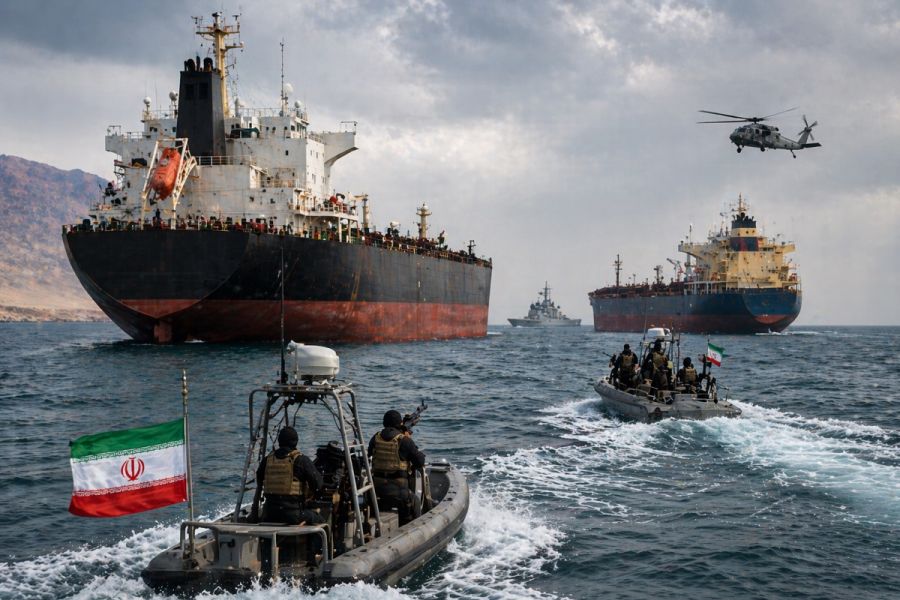
Tehran - Iran's elite naval forces on Wednesday seized two vessels in the Strait of Hormuz, in an apparent escalation of a tit-for-tat maritime standoff with the US following the capture of an Iranian ship in the nearby Oman Sea, amid a fragile ceasefire, an ongoing naval blockade and heightened tensions over access to a key global oil route.
In a statement, the naval arm of the Islamic Revolutionary Guard Corps (IRGC) said it had intercepted the ships - identified as the MSC Francesca, which it claimed is linked to Israel, and the Epaminodes - for alleged violations of newly imposed Iranian transit regulations. The IRGC said the vessels were operating without authorisation, committing repeated violations, tampering with navigation systems and attempting to leave the strait covertly, actions it said endangered maritime security.
The forces transferred both ships into Iranian territorial waters for inspection of cargo and documentation. The IRGC framed the operation as part of its "intelligence dominance" in the waterway and warned that any breach of Iran's maritime rules, or any attempt to disrupt newly announced transit laws, would be continuously monitored and met with "decisive and legal action".
Latest incident comes amid a broader confrontation following a US-led naval blockade of Iranian ports, which Tehran has condemned as an act of war and a violation of international law. Iranian forces have tightened control over the strait in recent days, rolling out a regulatory framework requiring all vessels to obtain prior clearance before transit.
A draft bill before parliament would formalise the measures requiring clearance for vessels from what Iran describes as "hostile countries" and impose transit fees.
The seizure unfolded just hours after US president Donald Trump announced an extension of a fragile ceasefire, even as he confirmed that US naval forces would continue enforcing the blockade. Tehran has rejected the move as a violation of the truce and warned it could attempt to break the blockade by force if tensions escalate further. Iran has not formally requested an extension of the ceasefire.
Despite the ceasefire extension, Iranian leadership has signalled readiness for renewed conflict. State media broadcast military parades, with long-range ballistic missiles on display, in Tehran overnight, underscoring a posture of defiance as negotiations faltered after talks expected to take place in Pakistan did not materialise.
The closure of the Strait of Hormuz - through which roughly a fifth of the world's oil supply typically passes, about 20m barrels per day - has already caused severe disruption to global shipping and energy markets, with prices rising sharply.
US extends Iran oil waivers
In Washington, Treasury secretary Scott Bessent announced a temporary 30-day extension of sanctions waivers on Iranian and Russian seaborne oil, citing appeals from vulnerable economies facing acute supply shortages. The requests, he said, came from finance ministers of about 10 countries during recent International Monetary Fund and World Bank meetings, reversing earlier indications that the waivers might not be renewed.
Meanwhile, evidence suggests the blockade is only partially effective. Shipping data cited by the Financial Times, based on tracking firm Vortexa, indicates that at least 34 tankers have managed to bypass US naval controls since mid-April. These include 19 vessels exiting the Persian Gulf and 15 entering it, with at least six tankers carrying Iranian crude valued at more than $900m.
One such vessel, the Iranian-flagged supertanker Dorena, reportedly left Iranian waters on 17 April and signalled its position off India's southern coast a day later.
Iranian political leaders have maintained a hard line. Mohammad Baqer Qalibaf, the Speaker of the Iranian Parliament, stated in a post on X that the United States failed to achieve its objectives through military aggression and will not do so through bullying.
"A complete ceasefire only holds meaning when it is not violated by a naval blockade," he said, adding: "The reopening of the strait is not possible while the ceasefire is being flagrantly violated."
As diplomatic efforts stall and military signalling intensifies, the confrontation risks deepening into a prolonged crisis with global repercussions for energy markets and international shipping lanes that depend on the narrow passage between the Gulf and the wider world.
Conversations
The opinions expressed in reader contributions are those of the respective author only, and do not reflect the opinions/views of Trans Asia News.