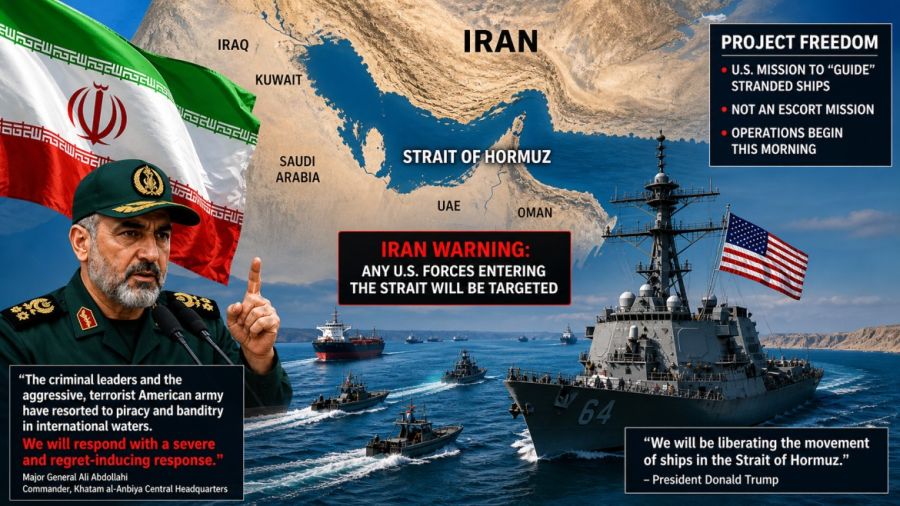
Tehran - Iran's military said on Monday it would target U.S. forces if they attempted to approach or enter the Strait of Hormuz, escalating tensions after U.S. President Donald Trump announced a naval initiative to guide ships through the vital oil transit route.
The warning came in a statement by Major General Ali Abdollahi, commander of Iran's Khatam al-Anbiya Central Headquarters, who said Tehran would confront any foreign military presence in the strait.
"The criminal leaders and the aggressive, terrorist American army" had resorted to "piracy and banditry in international waters", Abdollahi said, accusing Washington of endangering global trade and economic security.
He added that "the resistant and courageous Iranian nation" and its armed forces would respond to any threat with a "severe and regret-inducing response".
Abdollahi reiterated that the security of the Strait of Hormuz "is solely under the authority of the Islamic Republic of Iran's armed forces" and warned that all transit must be coordinated with Iranian forces. He urged commercial vessels to avoid entering the waterway without prior coordination, saying failure to do so would endanger their safety.
He also cautioned U.S. allies, saying "supporters of the wicked America" should avoid "any regrettable actions", and warned that any U.S. move to disrupt the situation would only complicate conditions and threaten shipping safety.
Trump said earlier that the United States would be "liberating the movement of ships in the Strait of Hormuz", adding that operations under what he called "Project Freedom" would begin "this morning, Monday", Middle Eastern time.
Guide, not escort
U.S. media outlets including The Wall Street Journal, CNN and Axios reported that U.S. officials were careful to describe the mission as one that would "guide" rather than "escort" vessels.
The Wall Street Journal said the mechanism "doesn't currently involve U.S. Navy warships escorting vessels through the strait," while CNN quoted a U.S. official as saying the initiative is "not an escort mission" and that the military would be "guiding stranded ships."
The Wall Street Journal also reported that European diplomats and shipowners questioned the plan's effectiveness, with one shipowner saying that being guided by a Western vessel could attract Iranian fire.
CNN said the proposal "leaves a lot of unanswered questions", citing an expert who suggested it was likely designed to make commercial ships "feel safe".
Escalating confrontation
Iran has restricted tanker traffic in the Strait of Hormuz since Feb. 28, when it says the United States and Israel launched airstrikes against the Islamic Republic. Tehran describes its actions as necessary to maintain security in the strategic waterway.
In a separate statement on Sunday, Iran's Islamic Revolutionary Guard Corps (IRGC) said Trump now faces a choice between "an impossible military operation" and "a bad deal" with Iran.
"Iran sets a Pentagon blockade deadline; China, Russia, and Europe shift tone against Washington; Trump's passive letter to Congress; acceptance of Iran's negotiating terms - there is only one way to read this: Trump must choose between 'an impossible military operation or a bad deal with the Islamic Republic of Iran'," the IRGC said. "The room for U.S. decision-making has narrowed."
The IRGC said Iran had submitted a comprehensive proposal aimed at ending what it called an "illegal U.S.-Israeli war of aggression", adding that Washington was seeking a "face-saving way to escape the war quagmire".
It also said Iranian forces had carried out "100 waves of successful retaliatory strikes" against U.S. and Israeli targets across the region.
The Strait of Hormuz, through which a significant portion of global oil supplies passes, remains one of the world's most sensitive maritime chokepoints, and any disruption there could have far-reaching economic consequences.
Conversations
The opinions expressed in reader contributions are those of the respective author only, and do not reflect the opinions/views of Trans Asia News.