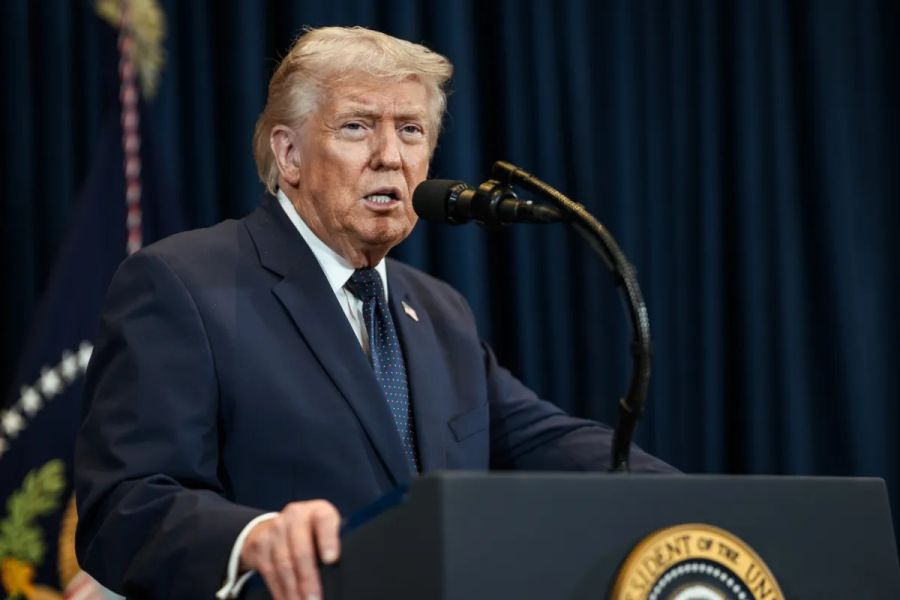
Washington- US President Donald Trump said in an expletive-laden social media post on Sunday that the United States will target Iran's power plants and bridges on Tuesday if the Strait of Hormuz is not reopened.
"Tuesday will be Power Plant Day, and Bridge Day, all wrapped up in one, in Iran. There will be nothing like it!!!" Trump said in a Truth Social post, referencing the key shipping lane that Tehran has effectively closed since the U.S. and Israel launched attacks on Iran more than a month ago.
"Open the F***n' Strait, you crazy bastrds, or you'll be living in Hell - JUST WATCH!" Trump said, ending his Easter morning post with: "Praise be to Allah.
A defiant Iran showed no sign of backing down, striking infrastructure targets linked to the US in neighbouring Gulf Arab countries and challenging the US account of rescuing a pilot of a downed jet. A top commander said new surprises await the US.
Amnesty International called Trump's threat "revolting".
"Iranian civilians will be the first to suffer from the destruction of power plants and bridges," Amnesty International head Agnes Callamard said on social media, calling Trump's threat "revolting".
Iran Calls Trump 'Unstable, Delusional Figure'
Hours after Trump's expletive-laden post promising Iran will be "living in Hell" over the Strait of Hormuz closure, Tehran's mission to the UN on Sunday called the open threats to target civilian infrastructure "a direct and public incitement to terrorise civilians and clear evidence of intent to commit war crimes".
"The international community and all States have legal obligations to prevent such atrocious acts of war crimes," the mission said in a post on the social platform X. "They must act now. Tomorrow is too late."Earlier Iran's culture minister on Sunday dismissed President Donald Trump's latest threats, calling the US leader an "unstable, delusional figure".
"Iranian society generally does not pay attention to his statements, as it believes he lacks personal, behavioural and verbal balance and constantly shifts between contradictory positions," Sayed Reza Salihi-Amiri told The Associated Press in an interview Sunday.
"It seems Trump has become a phenomenon that neither Iranians nor Americans are able to fully analyze," said Salihi-Amiri.
He said the Strait of Hormuz is "open to the world but closed to Iran's enemies."
US describes a dramatic rescue
Trump has issued such deadlines before but extended them when mediators have claimed progress toward ending the war, which has killed thousands, shaken global markets, cut off key shipping routes and spiked fuel prices in just over five weeks.
Both sides have threatened and hit civilian targets like oil fields and desalination plants critical for drinking water, bringing warnings of possible war crimes.
The rescue of the US aviator followed an intense search after Friday's crash of the F-15E Strike Eagle, while Iran promised a reward for anyone who turned in an "enemy pilot."
Trump said that the service member was "seriously wounded and really brave" and rescued from "deep inside the mountains". He said a second crew member was rescued in "broad daylight" within hours of the crash.
The fighter jet was the first known American aircraft to crash in Iranian territory since the US and Israel launched the war with strikes on Iran on Feb 28.
Iran also shot down another US military plane, demonstrating both the perils of the bombing campaign and the ability of Iran's degraded military to hit back. Neither the status of the US A-10 attack aircraft's crew nor where it crashed is known.
On Sunday, Iran's state television aired a video showing what it claimed were parts of US aircraft shot down by Iranian forces, along with a photo of thick, black smoke rising. The broadcaster said that Iran had shot down a transport plane and two helicopters that were part of the rescue operation.
Iran's military joint command, which said that four US aircraft were destroyed during the operation, warned of stepping up retaliatory attacks on regional oil and civilian infrastructure if the US and Israel attack such targets in the Islamic Republic, according to state television.
"We once again repeat: if you commit aggression again and strike civilian facilities, our responses will be more forceful," a spokesman said in comments published by the IRNA news agency.
The laws of armed conflict allow attacks on civilian infrastructure only if the military advantage outweighs the civilian harm, legal scholars say. It's considered a high bar to clear, and causing excessive suffering to civilians can constitute a war crime.
Conversations
The opinions expressed in reader contributions are those of the respective author only, and do not reflect the opinions/views of Trans Asia News.