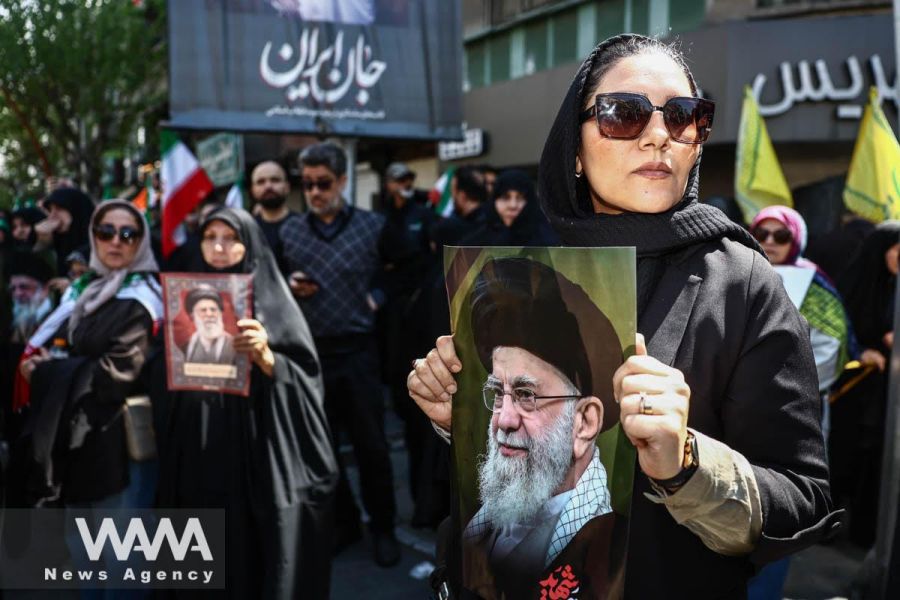
Tehran - In a massive display of national mourning, vast crowds of Iranians took to the streets of the capital and across the nation on Thursday to mark the 40th day following the assassination of Supreme Leader Ayatollah Seyyed Ali Khamenei, senior military officials, and schoolchildren from Minab, reports said.
The massive mourning processions commenced on Thursday morning, with participants marching from Jomhouri Square to the site where the former Leader w as assassinated by the US & Israel in a joint operation.
Ayatollah Khamenei (86) was assassinated 40 days ago in a targeted attack on his residence in Tehran--an incident that shook the region, triggering a devastating war and worldwide protests. Several members of the leader were also killed in the attack.
The ceremony symbolically began at 9:40 a.m.--coinciding with the exact time of the assassination--and continued until 8:00 p.m.
In Tehran, mourning processions started early in the morning from various routes, especially from Revolution Square, moving toward the site of the assassination. Iran's President Masoud Pezeshkian also attended the commemorative ceremony in Tehran's Jamhuri (Republic) Square on Thursday.
Meanwhile, since Wednesday night, groups o f people had already begun moving toward main squares and designated mourning locations after the evening prayers from mosques and religious halls.
Reports said large crowds had gathered at designated locations even before the official start of the ceremony.
The central streets of the capital--especially those leading to the site of the assassination--were filled with mourners chanting slogans and performing religious hymns to honour the memory of the former leader of the Islamic Republic.
In many cities, processions were taken to the streets and religious centres to perform Arbaeen rituals, with some areas witnessing massive public gatherings.
As part of the programmes, a recorded message of the late leader was to be broadcast nationwide at 9:00 p.m. Additionally, according to official announcements, further memorial ceremonies are scheduled for Friday (April 10) starting at 10:00 a.m. in large prayer grounds across the country.
Regional Reactions and Consequences
The strike on Bayt-e-Rahbari, as the leader's residence is known in downtown Tehran, also claimed the lives of several high-ranking military commanders and advisers, including Major General Abdolrahim Mousavi, Rear Admiral Ali Shamkhani, and Major General Mohammad Pakpour. One of the most devastating incidents occurred on the first day of the hostilities, when a primary school in Minab was struck by US tomohawk missiles, leading to the deaths of more than 170 children and some of their teachers.
The assassination of Iran's leader, as an unprecedented event, has generated widespread reactions across the region and the world and has been described by many analysts as a turning point in the geopolitical history of the Middle East.
Holding fortieth-day ceremonies for the slain leader of the Islamic Republic, within the framework of the Arbaeen religious tradition, is seen as an effort to redefine this event as a "historical-ideological" moment.
Within this context, the large public turnout in today's ceremonies has been presented by organisers as a sign of continued popular support and a renewed pledge of allegiance to the political and ideological path of the governing system established following the triumph of the popular revolution that toppled the US backed Iranian monarchy in 1979.
IRGC Pledge
In a statement released on Thursday, the Islamic Revolution Guards Corps (IRGC) said that the martyrdom of Ayatollah Khamenei was as effective as his lifetime presence in the promotion of the Islamic Revolution and the Islamic Republic.
It also enumerated the resistance and unity of the Iranian nation and the Islamic establishment, as well as 100 fatal strikes by the Iranian armed forces and the enemies' humiliating retreats, as parts of the blessings of the Leader's pure blood during the imposed war.
Ayatollah Khamenei's thought, discourse, conduct and command in the fields of resistance, independence, progress, justice, unity, fight against oppression, and spirituality form a comprehensive system for governing the country, it added.
Conversations
The opinions expressed in reader contributions are those of the respective author only, and do not reflect the opinions/views of Trans Asia News.