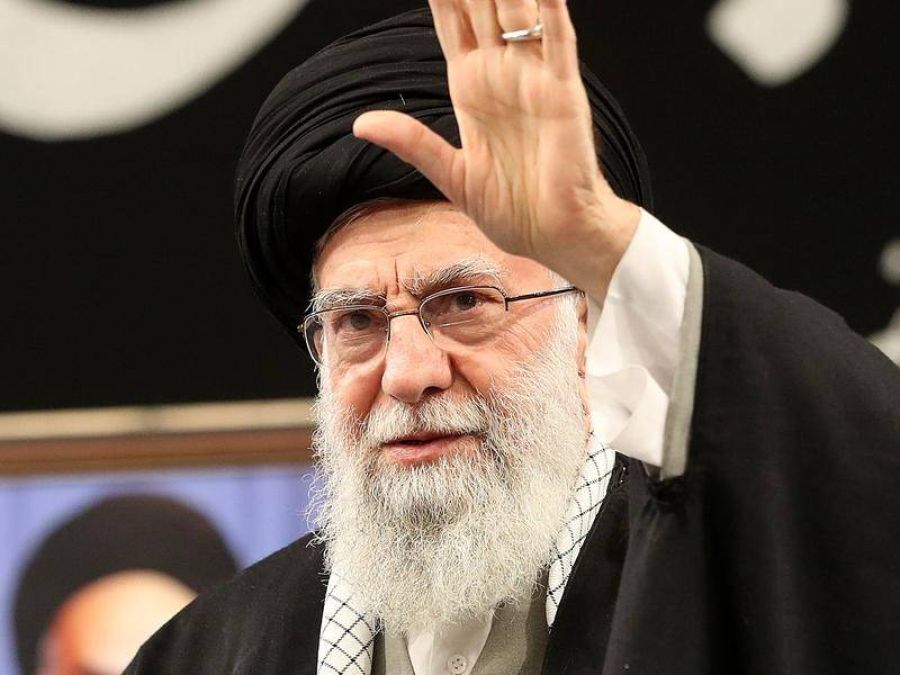
Tehran - Supreme Leader Ayatollah Sayyed Ali Hossaini Khamenei has been assassinated by Israel in a massive strike on his office in the Iranian capital, Iranian authorities confirmed early Sunday morning.
Iranian state television interrupted regular programming with a solemn recitation of the Quran, broadcasting the news alongside a photograph of the 86-year-old leader, who is also regarded as a Grand Marja in the Shia Muslim world. The announcement has sent shockwaves across Iran and the broader Middle East.
"The Supreme Leader of Iran Has Reached Martyrdom," state broadcaster IRIB reported on Sunday morning.
The Supreme National Security Council issued a statement confirming the death of Ayatollah Khamenei, in what it described as a 'criminal attack by Israel and the United States'.
The Supreme Leader of the Islamic Republic of Iran, Ayatollah Ali Khamenei, was assassinated at his workplace in the Leader's Office (Beit-e Rahbari), Wana News reported.
"At the moment of his martyrdom, he was carrying out his official duties and was present at his place of work (his office). The attack took place in the early hours of Saturday morning," the report added.
Khamenei's daughter, son-in-law and grandchild were also killed in the attack, the semi-official Iranian news agency Fars reported.
Fars, which is linked with the Islamic Revolutionary Guard Corps, also reported that a daughter-in-law of the leader was also killed in the strike.
Earlier, US President Donald Trump stated that Ayatollah Khamenei had been killed in what he described as a joint American-Israeli operation targeting Iran.
The assassination of Iran's Supreme Leader marks one of the most consequential geopolitical events in decades.
Ayatollah Khamenei dramatically remodelled the Islamic Republic since he took the reins after the death of Ayatollah (Imam) Ruhollah Khomeini in 1989.
Imam Khomeini was the fiery, charismatic ideologue who led the overthrow of the US-backed Shah and founded the Islamic Republic with a senior religious jurist acting as supreme guide (Vali-e-Faqih). Sayyed Khamenei is credited with turning that revolutionary vision into a state establishment. Ayatollah Khamenei shaped the country's domestic policy, regional strategy, and relations with the West for more than three decades.
Sayyed Khamenei was born into a religious family in the northeastern holy city of Mashhad, a hotbed of revolutionary fervour during the struggle against the Western-allied Shah Reza Pahlavi.
Like many other Iranian leaders, he studied under Ayatollah Khomeini at the seminary in the holy city of Qom, south of Tehran, in the early 1960s, before his exile to Iraq and France.
Sayyed Khamenei joined the anti-Shah movement, facing time in both prison and hiding. When Ayatollah Khomeini returned to Iran in triumph in February 1979 and established the Islamic Republic, Ali Khamenei was appointed to the Revolutionary Council. In 1981, he was elected Iran's third president; that same year, a terror attack during Friday prayers left him with one hand paralysed.
It was widely believed Ali Khamenei lacked the steely gaze and fiery aura of Imam Khomeini, the father of the Islamic Revolution. He fell far short of Imam Khomeini's religious scholarship, holding the relatively low rank of "hojatolislam" in the Shia clerical hierarchy. After being named supreme leader after Imam Khomeini's demise, Sayyed Khamenei acknowledged the doubts with humility. "I am an individual with many faults and shortcomings and truly a minor seminarian," he said in his first speech in his new post.
Iran during Ali Khamenei's tenure
Over more than three decades, Ali Khamenei positioned scientific advancement at the centre of Iran's national strategy, framing technological progress as both a symbol of sovereignty and a tool of resistance against Western pressure.
A cornerstone of his vision was the expansion of Iran's civilian nuclear programme. Ayatollah Khamenei consistently described nuclear technology as a sovereign achievement "more valuable than oil", and he authorised research efforts that ultimately led to the development of a complete nuclear fuel cycle despite intense international scrutiny and sanctions. Under his leadership, nuclear capability became not only an energy policy priority but also a defining element of Iran's geopolitical posture.
Beyond nuclear technology, he strongly promoted strategic sectors such as nanotechnology, aerospace engineering, biotechnology, and stem cell research. He repeatedly urged Iranian scientists to push beyond existing global scientific boundaries, calling for what he described as a national "scientific leap". This initiative included a long-term ambition for Iran to become a leading global producer of knowledge within 50 years, with aspirations for Persian to emerge as a recognised language of scientific innovation.
Central to this agenda was the development of a knowledge-based economy. Sayyed Khamenei emphasised the importance of elite researchers, academic institutions, and technology-driven companies in addressing domestic challenges and circumventing economic restrictions. Support for start-ups and innovation-driven enterprises was framed as a pathway to economic resilience amid tightening sanctions.
Throughout his tenure, Khamenei portrayed scientific progress as a form of national defence -- an asset that, in his view, could not be destroyed by military threats or external pressure. His approach blended rapid technological development with a broader ideological commitment to independence from Western influence, aiming to build a self-reliant scientific infrastructure capable of sustaining Iran's long-term strategic ambitions.
The supreme leader remained deeply suspicious of the US, referring to it as the "Great Satan" even after President Barack Obama came into office in 2009, offering dialogue and a fresh start.
Western disdain
He shrugged off UN sanctions and pushed ahead with Iran's nuclear programme, which the US and its allies say hid a secret project to build a nuclear weapon up until 2003. Ayatollah Khamenei issued a fatwa, or religious ruling, that nuclear weapons are un-Islamic but vowed the country would never give up its right to develop a peaceful nuclear energy programme.
Under Iran's 2015 nuclear deal with world powers, Tehran agreed to drastically reduce its stockpile and enrichment of uranium in exchange for the lifting of economic sanctions. But only three years later, Trump, in his first term, unilaterally withdrew Washington from the accord, arguing it didn't go far enough.
Although Ayatollah Khamenei struggled to preserve the ideological purity of the Islamic Revolution, Iran's government has largely failed to rid the country of Western influence. Scores of Western-funded satellite channels bombard Iran 24x7 with propaganda against the Islamic system and exhort people to rise.
Ayatollah Khamenei's first major challenge came in 1997, when pro-reform politicians gained control of parliament and cleric Mohammad Khatami was elected president by a landslide, riding a large youth vote. The reformists demanded a loosening of the strict social rules imposed by the revolution and called for improved ties with the outside world, including the US.
Ayatollah Khamenei's death in a US-Israeli military strike would dramatically escalate tensions in the Middle East, potentially triggering severe regional instability, retaliatory actions, and far-reaching global political and economic repercussions.
Conversations
The opinions expressed in reader contributions are those of the respective author only, and do not reflect the opinions/views of Trans Asia News.