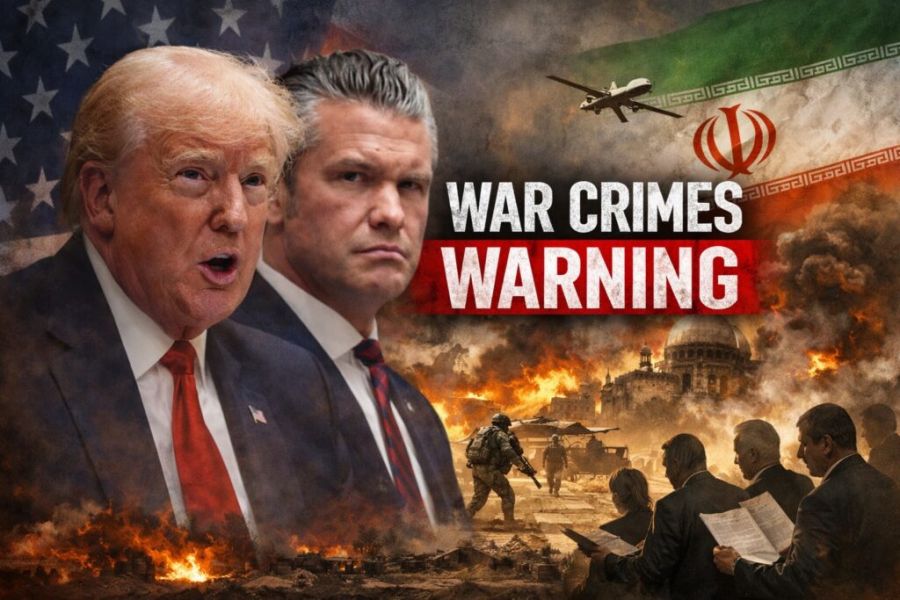
London - As President Donald Trump openly brags about his military actions in Iran and signals the possibility of further escalation, alarm is growing among legal experts worldwide. More than 100 international law scholars across the United States have issued a stark warning that both the rhetoric and conduct of the Trump administration in the intensifying conflict could amount to war crimes--raising serious concerns across the global legal and diplomatic community.
In an open letter published Thursday by the Just Security policy journal, scholars from leading institutions including Harvard, Yale, Stanford, and the University of California said statements from senior U.S. officials and the conduct of American forces "raise serious concerns about violations of international human rights law and international humanitarian law, including potential war crimes."
The warning comes after Trump, in a televised address Wednesday, signalled a dramatic escalation in the conflict, stating that the United States could strike Iran's energy and oil infrastructure if Tehran fails to meet Washington's demands.
"We are going to hit them extremely hard over the next two to three weeks," Trump said. "We are going to bring them back to the Stone Ages, where they belong."
The letter also cited an earlier mid-March remark by Trump suggesting strikes could be carried out "just for fun", as well as comments from War Secretary Pete Hegseth, who said the U.S. does not fight with "stupid rules of engagement".
Legal experts expressed particular concern over reports of civilian casualties. The letter referenced strikes that hit schools, health facilities, and homes, including a devastating February 28 attack on a girls' primary school in the Iranian city of Minab. According to the Iranian Red Crescent, 175 students were killed. The U.S. military later acknowledged it had elevated its investigation into the strike after evidence suggested American forces were likely responsible.
The United States and Israel have also carried out multiple attacks on medical facilities in the course of their war on Iran.
On Thursday the US-Israeli warplanes attacked and destroyed the Pasteur Institute of Iran - the oldest and most prestigious research and public health centre in the Middle East. The institute conducts research on infectious diseases, produces vaccines and biological products and provides advanced diagnostics.
The US military on Thursday executed a double-tap strike on a highway bridge outside of Tehran, killing a dozen people and injuring 90 others.
The two strikes reportedly struck the bridge roughly an hour apart, with the second arriving while emergency responders, who are considered protected civilians, were assisting the wounded.
In a post on Truth Social Thursday night, the U.S. president appeared to celebrate that strike and promise more destruction like it.
"Our Military, the greatest and most powerful (by far!) anywhere in the World, hasn't even started destroying what's left in Iran. Bridges next, then Electric Power Plants! New Regime leadership knows what has to be done, and has to be done, FAST!" Trump wrote.
The conflict began on February 28, when U.S. and Israeli forces launched coordinated attacks on Iran. Tehran retaliated with strikes on Israel and U.S. military bases and its business assets across the Gulf region. Since then, joint U.S.-Israeli operations in Iran and Israeli attacks in Lebanon have so far killed thousands and displaced millions.
In a separate report, former U.S. Ambassador-at-Large for War Crimes Issues Stephen J. Rapp warned that Trump's rhetoric risks undermining America's standing in international law.
"It makes us a rogue state," Rapp said, responding to Trump's threat to destroy Iran's power stations and desalination plants if the Strait of Hormuz is not reopened.
Trump wrote on Truth Social that if a deal is not reached, the U.S. would "blow up and completely obliterate all of their Electric Generating Plants, Oil Wells and Kharg Island (and possibly all desalinization plants!)."
Rapp stressed that targeting desalination plants--critical sources of drinking water for millions--"would definitely be a war crime. Not much question about that."
Kenneth Roth, former executive director of Human Rights Watch, echoed this assessment, stating: "Even attacks on power plants are war crimes," noting that Iran's unified electrical grid serves both civilian and military needs. "The harm to civilians ... is clearly disproportionate to any military benefit," he added.
Under international humanitarian law, civilian infrastructure cannot be targeted unless it is being used for military purposes--and even then, attacks must meet strict proportionality standards.
Other experts warned that even the threats themselves may carry legal consequences. "Threatening to carry out a war crime can be considered a war crime in and of itself," Roth said, adding that such statements could demonstrate criminal intent if attacks are executed.
David J. Scheffer, the first U.S. ambassador-at-large for war crimes issues, cautioned that while he would not immediately label the United States a "rogue state," the international community is closely watching.
"The entire international community will be watching the conduct of U.S. forces in the Iran war," he said, warning that global judgment could conclude the U.S. is not complying with international law.
The United States and Israel are not signatories to the International Criminal Court, which prosecutes war crimes, genocide, and crimes against humanity--further complicating accountability mechanisms.
Meanwhile, critics within and outside government say the rhetoric signals a troubling shift. Josh Paul, a former State Department official, warned of a growing "willingness to commit" potential war crimes, while Annelle Sheline, who resigned over U.S. policy in the Middle East, described Trump's language as "alarming," especially in the context of widespread destruction in Gaza.
Hala Rharrit, a veteran U.S. diplomat who stepped down in 2024, said such normalization is dangerous.
"Once hospital after hospital, school after school got bombed... it became so normalized," she said. "Now, when Trump makes the threat of attacking civilian infrastructure, many people don't even bat an eye."
Rapp warned that beyond immediate consequences, such rhetoric risks setting a global precedent.
"It creates a permission structure for others to threaten or commit similar crimes," he said, cautioning that the long-term impact could erode decades of international legal norms established after World War II.
As tensions rise and the conflict deepens, the debate over legality, morality, and accountability continues to intensify--both within the United States and across the international stage.
Conversations
The opinions expressed in reader contributions are those of the respective author only, and do not reflect the opinions/views of Trans Asia News.