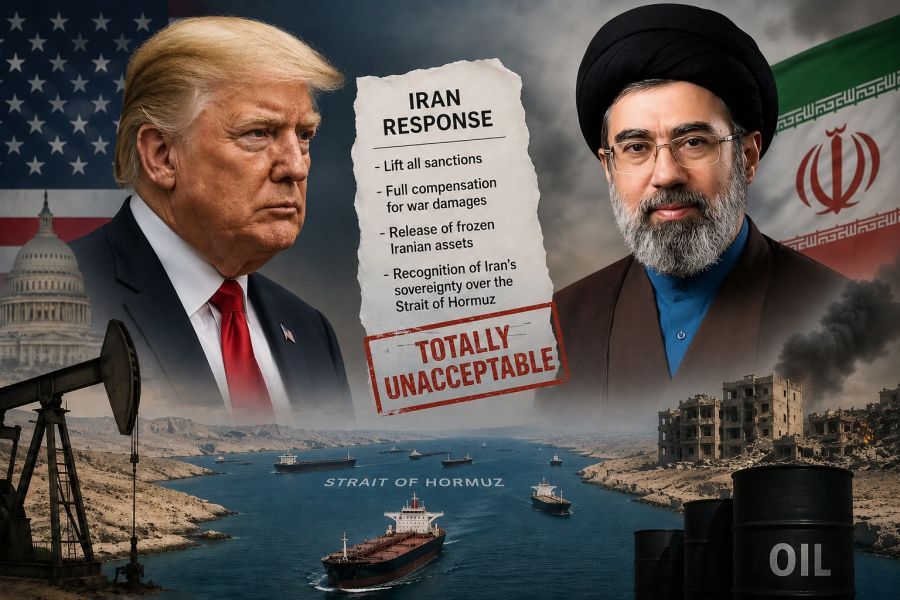
Washington/Tehran - President Donald Trump has rejected Iran's response to a U.S. proposal to end months of conflict, calling it "totally unacceptable" and casting doubt on prospects for renewed negotiations, as disagreements persist over sanctions, war reparations and control of the Strait of Hormuz, and some Republicans press for possible military action despite an ongoing ceasefire.
Trump said he had reviewed the Iranian reply, delivered via Pakistani mediators on Sunday, and reacted sharply. 'I have just read the response from Iran's so-called 'Representatives.' I don't like it -- TOTALLY UNACCEPTABLE!" he wrote on his Truth Social platform.
Speaking later to Axios, he reiterated his position without elaboration. "I don't like their letter. It's inappropriate. I don't like their response," he said.
The exchange comes amid a fragile ceasefire agreed on 8 April, weeks after the US and Israel launched war on Iran on 28 February. Iran has since carried out widespread retaliatory strikes under what it calls "Operation True Promise 4".
The war has had global consequences, particularly after Iran imposed restrictions on the Strait of Hormuz, a key maritime route for roughly a fifth of global oil supplies, contributing to fuel shortages in several countries.
Iran has since established a mechanism to collect tolls from ships transiting the strait, asserting its sovereign rights as a coastal state. US officials have dismissed any such control as "unacceptable", but Iran insists the strait's security is a regional matter.
According to Iran's state broadcaster IRIB, Tehran's response includes demands for full compensation for war damage, the lifting of all sanctions, the release of frozen Iranian assets, and recognition of Iran's sovereignty over the strait - a position the US has been reluctant to publicly accept.
Trump said he discussed the Iranian response with Israeli prime minister Benjamin Netanyahu on Sunday. "It was a very nice call. We have a good relationship," he said, adding that the Iran negotiations are "my situation, not everybody else's".
Meanwhile, Iranian leadership remains defiant. Reacting to Trump's rejection, Tasnim News Agency, said to be reflecting views of the IRGC, said, "Nobody in Iran writes a plan to please Trump. Trump simply does not like reality; that is why he keeps losing to Iran." The response, it said, "emphasises the fundamental rights of the Iranian nation" and rejects Washington's earlier plan, which Iran views as coercive.
Meanwhile, responding to critics of talks with the US, President Masoud Pezeshkian said engagement did not imply capitulation. "We will never bow down to the enemy," he wrote on X, adding that dialogue "does not mean surrender or retreat".
In Washington, some Republicans have pushed for escalation. War hawk Senator Lindsey Graham urged Trump to consider a "military option".
However, Mark Pfeifle, a former U.S. national security adviser, told Al Jazeera that a return to full-scale war appeared unlikely, noting that U.S. officials had recently said "Operation Epic Fury" was over.
"They are pretty much at the same place they were before negotiations began," Pfeifle said.
Tehran has not indicated whether further talks will take place, but officials maintain that any negotiations must be based on respect for Iran's sovereignty rather than what they describe as imposed demands.
Conversations
The opinions expressed in reader contributions are those of the respective author only, and do not reflect the opinions/views of Trans Asia News.