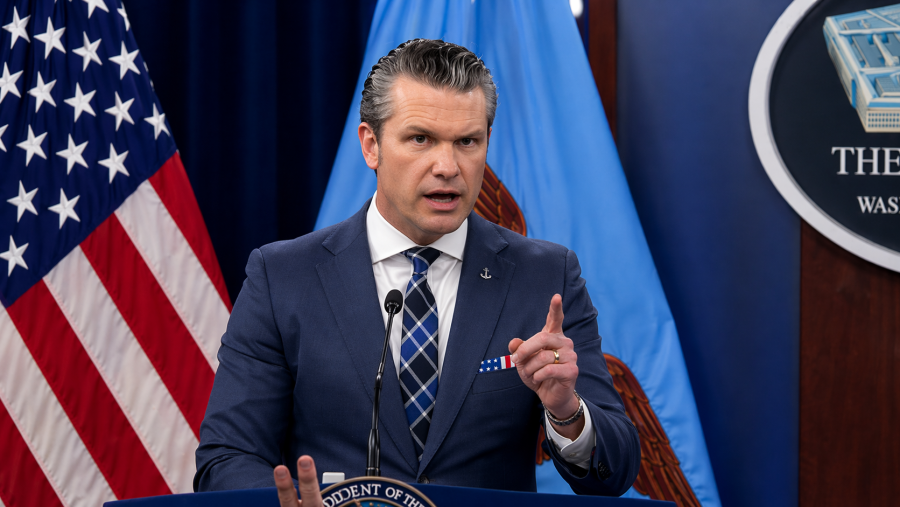
Washington: US defence secretary Pete Hegseth has praised Gulf Arab allies for their "exceptional" support during Washington's recent military campaign against Iran, highlighting deepening regional cooperation even as he criticised other partners for failing to step up.
Speaking at a Pentagon briefing on Thursday, Hegseth said countries including Bahrain, Saudi Arabia, the United Arab Emirates, Qatar, Kuwait and Jordan had played a crucial role in supporting US operations during what he described as "Operation Epic Fury".
"They have been exceptional teammates," he said, pointing to their contribution to regional defence efforts and coordination with US forces during the conflict.
The remarks come as the US maintains a military blockade against Iran and a fragile ceasefire remains in place following weeks of fighting.
Admiral Bradley Cooper, the US Central Command (Centcom) chief, echoed Hegseth's assessment, saying cooperation with Gulf allies had strengthened during the conflict. He said US forces had worked "side-by-side" with regional militaries to build what he described as the "largest air defence umbrella in the world" across the Middle East.
Cooper added that Gulf leaders had expressed strong support for US troops, noting that senior figures in Bahrain, including the king and crown prince, had personally recognised American personnel deployed in the country.
"This is a sentiment that is widely shared across every Gulf ally," he said. "I heard this message over and over again - we stand with you."
The US has deployed tens of thousands of personnel across the region, with more than 50,000 service members operating from over 70 locations, according to Centcom. American forces have been engaged in air defence, naval operations and strikes on Iranian military infrastructure during the conflict.
Hegseth contrasted the role of Gulf partners with what he described as a lack of meaningful support from other allies outside the region.
"There's a lot of talk," he said, adding that many countries had failed to contribute when it mattered most. "When shots were fired and those countries were needed, they weren't there."
He suggested that countries reliant on energy flows through the Strait of Hormuz - particularly in Europe and Asia - should take greater responsibility for securing key maritime routes rather than depending on the US Navy.
"We should live in a world where other countries can defend waterways, not just the United States," he said.
The Pentagon said US naval forces are currently enforcing a blockade targeting Iranian ports and shipping, with thousands of personnel, warships and aircraft involved in the operation.
Despite the ceasefire halting major combat operations, US officials said forces remain on high alert and ready to resume action if diplomacy fails.
The US has also sought to emphasise the strength of its military partnerships in the region, particularly with Israel and Gulf states, as it continues to pursue a broader strategy aimed at curbing Iran's military capabilities and preventing it from developing a nuclear weapon.
While Washington has welcomed the support of its Middle Eastern allies, Hegseth's comments underline growing frustration within the Trump administration over what it sees as an imbalance in global security responsibilities.
Conversations
The opinions expressed in reader contributions are those of the respective author only, and do not reflect the opinions/views of Trans Asia News.