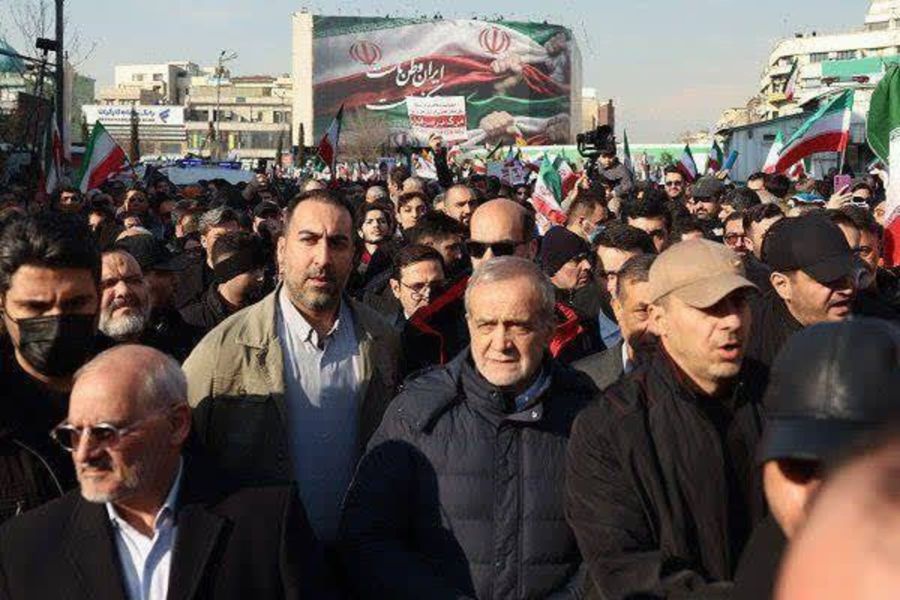
New Delhi --Amid the ongoing US-Iran war, now in its second month, and intensifying rhetoric from Washington, Iranian President Masoud Pezeshkian has issued a strongly worded public letter to the American people, defending Tehran's position and questioning the rationale behind the US-Israeli war on Iran.
The message comes as US President Donald Trump has escalated threats of "obliterating" strikes on Iran's critical civilian infrastructure--including power grids, oil facilities and desalination plants--moves that legal experts have warned could amount to war crimes.
Civilisational Identity, Not Aggression
Framing Iran's stance through history, Pezeshkian wrote, "Iran--by this very name, character, and identity--is one of the oldest continuous civilizations in human history. Despite its historical and geographical advantages at various times, Iran has never, in its modern history, chosen the path of aggression, expansion, colonialism, or domination."
He added: "Even after enduring occupation, invasion, and sustained pressure from global powers--and despite possessing military superiority over many of its neighbours--Iran has never initiated a war. Yet it has resolutely and bravely repelled those who have attacked it."
No Hostility Towards People
Drawing a distinction between governments and citizens, the Iranian president said, "The Iranian people harbor no enmity toward other nations, including the people of America, Europe, or neighboring countries."
"Iranians have consistently drawn a clear distinction between governments and the people they govern. This is a deeply rooted principle in Iranian culture and collective consciousness--not a temporary political stance."
Rejecting the 'Threat' Narrative
Pezeshkian dismissed the portrayal of Iran as a global threat: "Portraying Iran as a threat is neither consistent with historical reality nor with present-day observable facts."
"What Iran has done--and continues to do--is a measured response grounded in legitimate self-defense, and by no means an initiation of war or aggression."
Roots of Distrust
Tracing tensions back decades, Pezeshkian cited the 1953 Iranian coup d'etat: "The turning point... was the 1953 coup d'etat--an illegal American intervention aimed at preventing the nationalization of Iran's own resources."
"That coup disrupted Iran's democratic process, reinstated dictatorship, and sowed deep distrust among Iranians toward US policies."
He added that distrust deepened due to US support for the Shah, backing of Iraq during the 1980s war, sanctions, and "unprovoked military aggression--twice, in the midst of negotiations."
Resilience Amid Pressure
Highlighting domestic gains, he said: "All these pressures have failed to weaken Iran. On the contrary, the country has grown stronger in many areas."
"Literacy rates have tripled--from roughly 30% before the Islamic Revolution to over 90% today."
"Higher education has expanded dramatically; significant advances have been achieved in modern technology; healthcare services have improved; and infrastructure has developed at a pace and scale incomparable to the past."
Human Cost of War
The Iranian president warned of the toll on civilians: "The destructive and inhumane impact of sanctions, war, and aggression on the lives of the resilient Iranian people must not be underestimated."
"When war inflicts irreparable harm on lives, homes, cities, and futures, people will not remain indifferent toward those responsible."
Questions for Americans
In a direct appeal, he asked: "Exactly which of the American people's interests are truly being served by this war?"
"Was there any objective threat from Iran to justify such behavior?"
"Does the massacre of innocent children, the destruction of cancer-treatment pharmaceutical facilities, or boasting about bombing a nation back to the Stone Age serve any purpose other than further damaging the United States' global standing?"
Collapse of Diplomacy
Referring to past agreements, he said: "Iran pursued negotiations, reached an agreement, and fulfilled all its commitments."
"The decision to withdraw from that agreement, escalate toward confrontation, and launch two acts of aggression in the midst of negotiations were destructive choices made by the U.S. government."
Israel Factor Raised
Pezeshkian also questioned Washington's alignment with Israel: "Is it not also the case that America has entered this aggression as a proxy for Israel...?"
"Is it not true that Israel... seeks to divert global attention away from its crimes toward the Palestinians?"
"Is it not evident that Israel now aims to fight Iran to the last American soldier and the last American taxpayer dollar...?"
'America First?' Questioned
He concluded with a pointed remark: "Is 'America First' truly among the priorities of the U.S. government today?"
Calling for a rethink, he urged: "Look beyond the machinery of misinformation... and instead speak with those who have visited Iran."
"Do these realities align with the distortions you are being told about Iran and its people?"
And Iran's president warned:
"Today, the world stands at a crossroads."
"The choice between confrontation and engagement is both real and consequential; its outcome will shape the future for generations to come."
"Throughout its millennia of proud history, Iran has outlasted many aggressors... while Iran endures--resilient, dignified, and proud."
Observers say even as the war grinds on without a decisive battlefield victory for either side, Iran's strategy appears focused on endurance and raising the conflict's political and economic costs. Crucially, Tehran is gaining traction in the war of narratives, they say.
President Pezeshkian's letter, framed as a direct appeal to Americans, is part of a calculated effort to challenge Washington's justification for the war and recast Iran as a victim of aggression. In a conflict where perception increasingly shapes power, this narrative push suggests that even without a decisive military win, Iran may be carving out a strategic edge.
Conversations
The opinions expressed in reader contributions are those of the respective author only, and do not reflect the opinions/views of Trans Asia News.