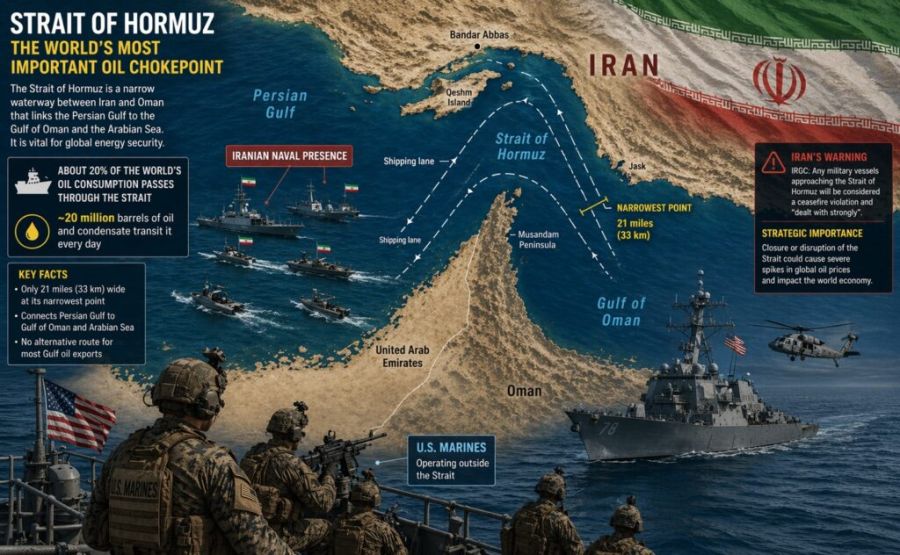
London - A United States decision to impose a sweeping maritime blockade on Iran has sharply escalated tensions in an already volatile region, raising urgent questions about legality, feasibility and the broader economic fallout of a confrontation centred on some of the world's most critical energy chokepoints.
According to US Central Command, the blockade came into force at 10am ET on 13 April, targeting all vessels entering or leaving Iranian ports regardless of nationality. The move, authorised by a presidential proclamation, follows the collapse of efforts to end hostilities between Washington, Israel and Tehran and comes amid Iran's continued closure of the Strait of Hormuz -- a corridor through which roughly a fifth of global oil supply typically flows.
According to US Central Command, the blockade came into force at 10am ET on 13 April, targeting all vessels entering or leaving Iranian ports regardless of nationality. The move, authorised by a presidential proclamation, follows the collapse of efforts to end hostilities between Washington, Israel and Tehran and comes amid Iran's continued closure of the Strait of Hormuz -- a corridor through which roughly a fifth of global oil supply typically flows.
Iran has responded with defiance. The Islamic Revolutionary Guard Corps warned that any military vessels approaching the Strait would be treated as violating a ceasefire and "dealt with strongly", while senior military adviser Mohsen Rezaei dismissed the US move as ineffective. "Just as the United States suffered a historic defeat in its attempt to clear the Strait, it will also fail in its naval blockade," he said, adding that Iran possesses "undisclosed capabilities" to counter it.
Tehran has also signalled that escalation could extend beyond the Gulf. Iranian officials have hinted at the possibility of exerting control over the Bab el-Mandeb Strait, a vital gateway to the Red Sea that carries an estimated 12% of global energy trade. Combined with the disruption in Hormuz, analysts warn this could remove up to a third of global energy supply from the market -- a shock likely to reverberate across economies already grappling with inflation.
Yet the practical implementation of a blockade raises complex legal and operational dilemmas. As Brazilian defence analyst Patricia Marins argues, the majority of vessels transiting the region are not Iranian. "The ships leaving the strait are not Iranian," she notes, "they are Pakistani, Iraqi, Indian, and above all, Chinese."
Interdicting such vessels in international waters would risk breaching established norms of maritime law and could draw third countries into the dispute. "He can impose a blockade on Iran," Marins said, referring to Donald Trump, "but seizing legally operating ships... simply because they are trading with an adversary... is far more complicated."
Even if enforced, the economic consequences may prove counterproductive. By constraining oil flows, the blockade is expected to tighten global supply and drive up prices -- a dynamic that could feed inflation worldwide, including in the United States. "The blockade increases pressure on Iran," Marins observed, "but it also fuels global inflationary pressure... where rising fuel prices quickly erode any president's popularity."
The assumption that economic isolation would quickly weaken Iran is also contested. Despite sanctions and sustained military pressure, Tehran retains significant alternative trade routes and domestic resilience. Rail links to Asia are projected to handle around $7bn in trade this year, while Caspian Sea routes offer additional capacity. Access to credit from Asian partners, particularly China, further cushions the impact of Western restrictions.
More fundamentally, analysts point to Iran's strategic geography and resource base. Holding up to 10% of the world's natural resources, the country is less vulnerable to external pressure than many policymakers assume. Marins argues that the conflict is not being decided by battlefield metrics alone. "This war is not about the number of ships, aircraft, or the quantity of missiles," she said. "It is about the strategic position in which Iran finds itself."
After weeks of sustained US and Israeli air operations that reportedly achieved high tactical precision but limited strategic effect, the blockade may signal a shift toward economic coercion. Whether that shift can succeed -- or instead deepen a crisis with global consequences -- remains an open question.
What is clear is that the stakes now extend far beyond the Gulf. Any disruption to Hormuz and Bab el-Mandeb would ripple through global energy markets, supply chains and political systems, testing not only the limits of US power but also the resilience of an increasingly interconnected world.
Conversations
The opinions expressed in reader contributions are those of the respective author only, and do not reflect the opinions/views of Trans Asia News.