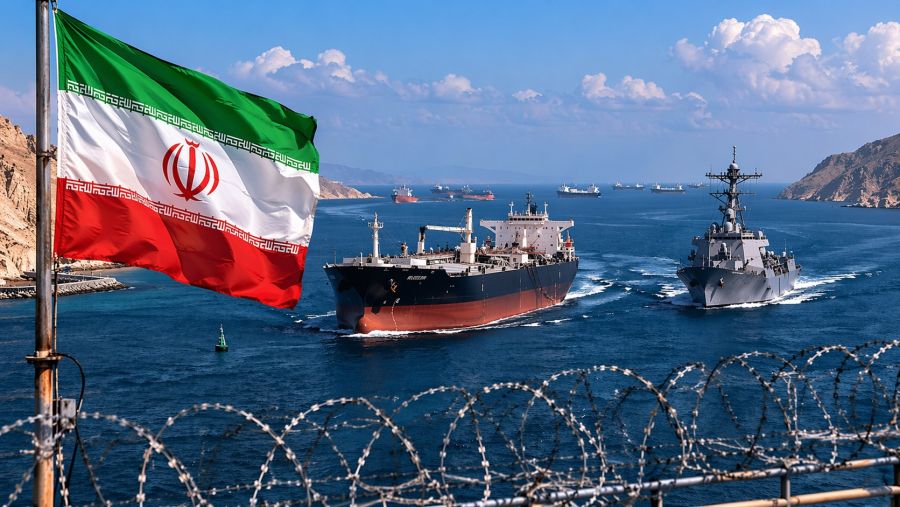
Dubai - A fragile opening in the Gulf collapsed on Saturday as Iran reimposed strict controls over the Strait of Hormuz, reversing a brief, conditional reopening. The move, triggered after Washington maintained its blockade and issued disputed claims about the waterway, has raised the dangers of renewed conflict and deepened fears for the world economy.
In a late-night statement, Iran's Revolutionary Guards navy declared the strait effectively closed until Washington lifts its blockade of Iranian ports, warning that "no vessel should make any movement from its anchorage in the Persian Gulf and the Sea of Oman, and approaching the Strait of Hormuz will be considered as cooperation with the enemy" and could be targeted.
The move reverses a brief, conditional reopening announced a day earlier and marks a renewed escalation in a confrontation that has entered its eighth week. Roughly one-fifth of the world's oil normally transits the strait, making the latest disruption a significant risk to already strained global energy markets.
A fragile ceasefire is due to expire by midweek, with Iranian officials confirming they have received new proposals from Washington. Pakistani mediators are working to convene another round of direct talks, though prospects remain uncertain.
Iran's Khatam al-Anbiya central military headquarters said earlier that "control of the Strait of Hormuz has returned to its previous state ... under strict management and control of the armed forces", citing what it described as continued US "maritime piracy".
The era of bullying has ended
Ebrahim Azizi, chair of the Iranian parliament's national security and foreign policy committee, said the reimposition of restrictions was a direct response to American "bad faith". He accused Washington of substituting "dreams" for reality and said its "black record" since the 1979 revolution showed that breaking promises was embedded in its political doctrine.
"While Trump, in cyberspace and through media under his control, tries to deceive public opinion and imply an agreement through dreaming and claiming contact with Iranian officials, the reality of the field is something else," Azizi said, adding that Iran would not be misled by "empty rhetoric".
He described US actions as "maritime piracy" rather than a legitimate blockade, arguing that Washington lacks the capability to enforce a full closure of Iranian trade routes. "The era of bullying has ended," he said, warning that any further pressure would be met with responses at "strategic chokepoints".
The current escalation follows a tightly choreographed sequence of events over the past 24 hours. Iran's foreign minister Abbas Araghchi had announced that, following a ceasefire in Lebanon, "the passage of all commercial vessels through the Strait of Hormuz is declared completely free for the remainder of the ceasefire period".
However, officials later clarified that the reopening was limited in scope: only commercial vessels were permitted, transit was restricted to designated routes, and passage required prior coordination with Iranian authorities. Military vessels remained barred entirely.
"This was not a full reopening but a controlled activation," one Iranian official said, describing a framework in which passage was conditional on broader ceasefire compliance, including developments in Lebanon.
The arrangement began to unravel after Donald Trump issued a series of public statements portraying the situation as a comprehensive reopening while insisting the US blockade would remain in place.
"Iran has agreed that it will never close the Strait again," Trump said, adding that "the Strait of Hormuz is completely open and ready for full trade and passage", even as he maintained that the "naval blockade ... will continue with full force" until a final agreement is reached.
Iranian officials rejected those claims as inconsistent with both the negotiated framework and the operational reality on the ground. "The opening and closing of the Strait of Hormuz does not happen in cyberspace; Iran is the decider of this important matter," a foreign ministry spokesperson said.
Mohammad Bagher Qalibaf, Iran's parliamentary speaker, echoed the criticism, saying: "The field determines whether the Strait is open or closed and its regulations, not social networks."
According to Iranian accounts, the limited reopening had been designed as part of a phased approach tied to the Lebanon ceasefire, with tolls, supervision and route controls built into the arrangement. But the continuation of US pressure measures - and conflicting narratives over the status of the strait - rendered the model untenable.
"Due to American bad faith and the continuation of maritime piracy, control of the Strait of Hormuz has returned to its previous state," a spokesperson for the Khatam al-Anbiya headquarters said.
Analysts say the episode highlights how the strait has evolved into a strategic lever in the broader confrontation. "Iran opened the Strait in a limited manner based on a specific condition ... Trump attempted to narrate this as a complete reopening ... and ultimately, with contradictory behaviour continuing, even that limited model was halted," said R Hejazi of WANA News Agency.
With shipping now effectively halted and warnings issued to vessels across the Gulf and Sea of Oman, the risk of further disruption -- and miscalculation -- is rising. As diplomatic efforts intensify ahead of the ceasefire deadline, the Strait of Hormuz has once again become both a flashpoint and a bargaining tool in a conflict with global economic implications.
Conversations
The opinions expressed in reader contributions are those of the respective author only, and do not reflect the opinions/views of Trans Asia News.