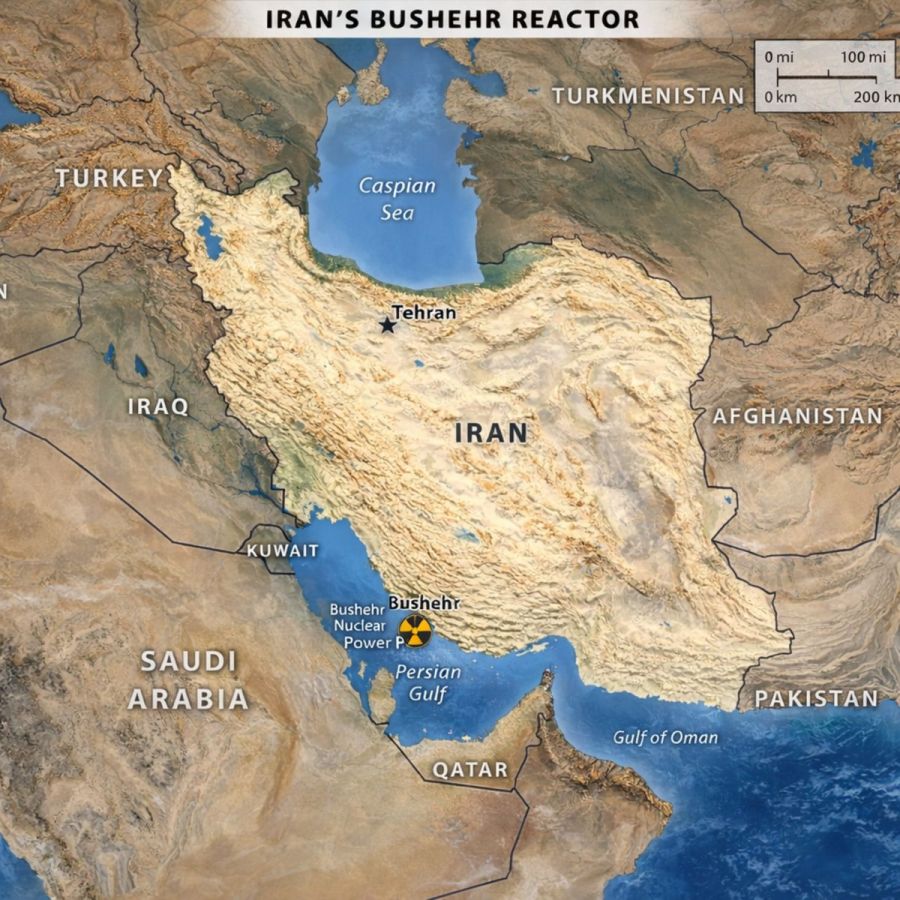
Tehran - Iran's foreign minister, Seyed Abbas Araghchi, warned on Saturday that continued strikes on Iran's nuclear facilities could trigger radioactive fallout affecting Gulf countries more than Iran itself, sharpening concerns about the regional risks of an expanding conflict.
In a statement posted on X, Araghchi pointed to repeated attacks on the Bushehr Nuclear Power Plant, Iran's only operational nuclear power station along the Persian Gulf coast. He said that any radioactive release would likely spread toward Gulf Cooperation Council states, whose capitals lie across the water, rather than inland toward Tehran.
"Radioactive fallout will end life in GCC capitals, not Tehran," he wrote, drawing a comparison to earlier Western alarm over fighting near the Zaporizhzhia Nuclear Power Plant during the war in Ukraine.
The remarks came as Iran escalated its diplomatic response, sending a formal letter late Saturday to the United Nations Secretary-General and members of the Security Council. In the letter, Araghchi described recent U.S. and Israeli strikes on Iranian nuclear facilities as a "clear violation of international law" and warned of potentially severe humanitarian and environmental consequences.
He said the attacks targeted facilities operating under the supervision of the International Atomic Energy Agency, raising the risk of radioactive contamination that could spread across the Gulf, a region that handles a significant share of global energy supplies and hosts densely populated coastal cities.
The Iranian government framed the strikes not only as a direct threat to its own infrastructure but as a broader regional danger. Bushehr's location on the Gulf's northern coast places it within close proximity to countries such as Saudi Arabia, Kuwait, Bahrain, Qatar and the United Arab Emirates, all of which could be exposed in the event of a nuclear incident.
Araghchi also criticized the response of international bodies, including the United Nations Security Council and the IAEA, saying they had failed to condemn the attacks or take preventive action. That inaction, he argued, risked emboldening further strikes on sensitive nuclear sites.
The warning adds a new dimension to the conflict, now in its sixth week, shifting attention from battlefield developments to the possibility of a cross-border environmental disaster. Analysts note that even limited damage to a nuclear facility like Bushehr -- while not comparable to a nuclear weapon -- could still release radioactive material into air or water currents, with consequences extending well beyond Iran's borders.
So far, there has been no immediate response from Washington or its allies to Iran's latest claims. But the prospect of contamination affecting Gulf states -- many of them key U.S. partners -- could increase pressure for international intervention or de-escalation efforts.
Conversations
The opinions expressed in reader contributions are those of the respective author only, and do not reflect the opinions/views of Trans Asia News.