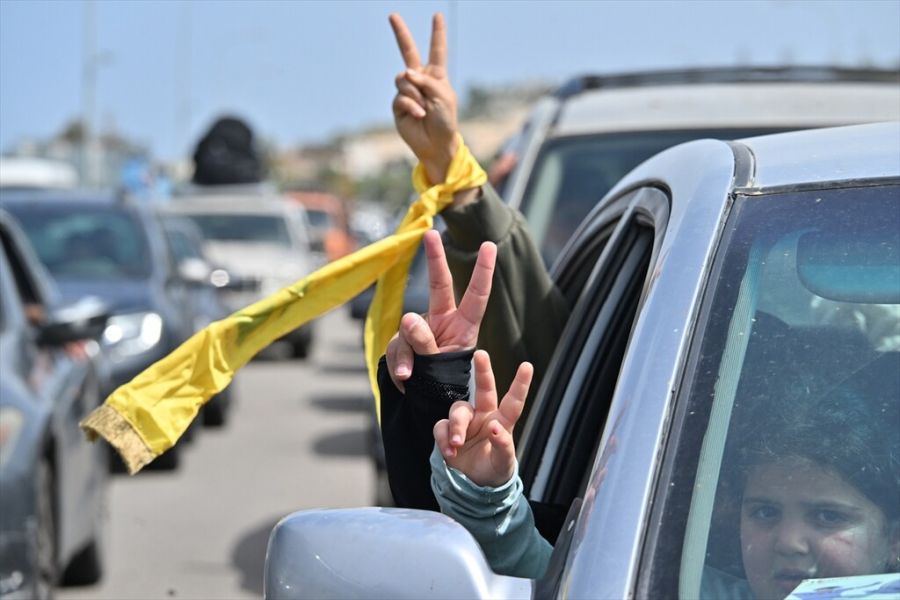
Beirut - A fragile ceasefire in Lebanon has exposed deep divisions between the United States and Israel, while analysts say the truce itself reflects an unexpected shift in leverage towards Iran and Hezbollah after weeks of devastating conflict.
According to Axios, Benjamin Netanyahu and his advisers were left "stunned" when Donald Trump announced that Washington would not allow Israel to carry out further strikes in Lebanon. The report, citing two people familiar with the matter, said Israeli officials scrambled to seek clarification after Trump declared the US had "prohibited" strikes as a 10-day ceasefire brokered by his administration came into force.
Under the agreement, Israel has halted offensive operations but retained the right to "take all necessary measures in self-defence at any time against planned, imminent, or ongoing attacks" -- a clause that has already drawn criticism for its breadth.
Hezbollah, which did not take part in the negotiations, has rejected the framework's terms, insisting that Israel must cease all troop movements in southern Lebanon and withdraw to positions held before fighting escalated more than a month ago.
The ceasefire comes after a sustained Israeli campaign that began in early March, when airstrikes hit Beirut and other cities and Israel expanded its so-called "security zone" in southern Lebanon. The offensive followed rocket fire by Hezbollah in support of Iran, pulling Lebanon deeper into a wider regional confrontation.
The human toll has been severe. Lebanese officials say nearly 2,200 people have been killed and around 1.2 million displaced since the escalation began, underscoring the scale of destruction that now frames the uneasy pause in fighting.
For some observers, however, the significance of the ceasefire lies less in its humanitarian relief than in what it reveals about shifting power dynamics. Rami Khouri, a professor at the American University in Beirut, argued that the outcome reflected pressure exerted by Tehran and Hezbollah on Washington and its ally.
"Hezbollah and Iran forced the United States and Israel to accept a ceasefire they did not really want, both in Lebanon and in Iran itself," Khouri told Doha-based Al Jazeera.
"The US and Israel tried to detach Lebanon from the Iran war but were forced to accept the ceasefire. It is quite remarkable how Iran and Hezbollah, two supposedly ravaged and obliterated entities, have been able to force the US and Israel to do this," he said.
Yet Khouri suggested the agreement also reinforces long-standing patterns in US policy. "This perpetuates, and perhaps aggravates, the tradition of the United States stepping in on the side of Israel and guaranteeing Israeli superiority, so that Israel can do whatever it wants," he said.
He pointed in particular to the language of the ceasefire document, arguing that "it favours the Israelis".
"They can attack any time they feel there is a threat, and historically, for Israel, a threat can mean a human being walking around saying they want to live free and with dignity in their own country," he said.
Questions also remain over Israel's military presence in southern Lebanon. Khouri argued that any withdrawal would depend on a much broader settlement. "They could leave all that territory if there is a permanent agreement, but a permanent agreement can only come if it is linked to the Iran situation and to the original Palestinian-Israeli conflict. That is why Hezbollah was born. That is why Iran got into fighting with Israel. And that issue will come up over and over again," he said.
Tehran has reinforced that linkage, reportedly making an end to Israeli operations in Lebanon a condition for any wider agreement with Washington and Tel Aviv.
For now, the ceasefire has brought a pause to the fighting but little clarity about what follows. With Hezbollah outside the agreement, Israel retaining broad latitude for military action, and regional tensions still tightly wound, the truce appears less a resolution than a temporary suspension in a conflict whose underlying drivers remain unresolved.
Conversations
The opinions expressed in reader contributions are those of the respective author only, and do not reflect the opinions/views of Trans Asia News.