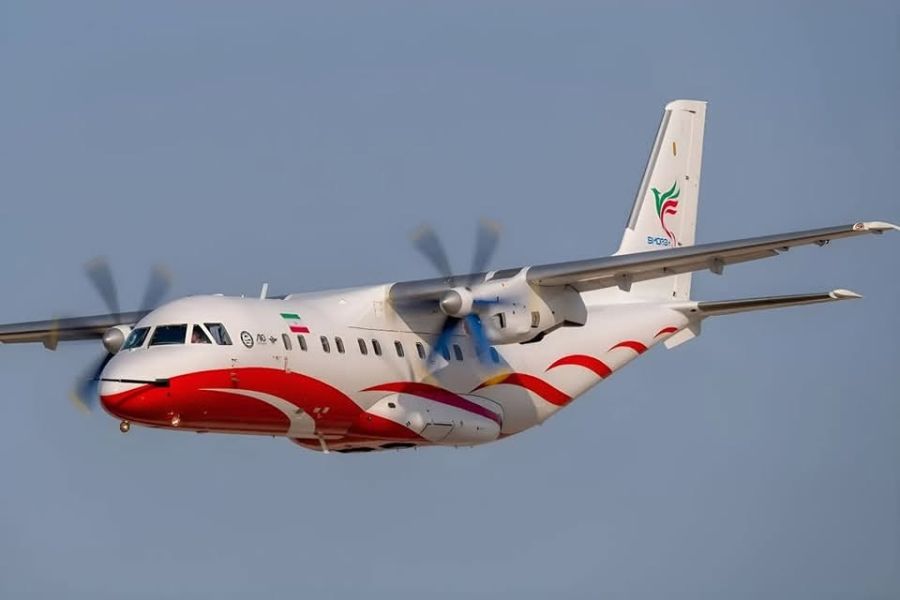
Tehran : Iran's long-awaited indigenous Simorgh transport aircraft has entered a decisive phase of development following its maiden flight, with authorities aiming to certify the aircraft and begin commercial operations by March 2027-March 2028, marking a significant milestone in Tehran's quest for self-reliance in aviation under decades of Western sanctions.
The successful first flight of the twin-engine turboprop aircraft has renewed attention on what Iranian officials describe as one of the country's most ambitious aerospace projects. While international observers have often compared the Simorgh to Ukraine's Antonov An-140, Tehran insists the aircraft represents a substantially redesigned indigenous platform capable of eventually replacing the ageing fleet of American-built Lockheed C-130 Hercules transport aircraft that have served Iran since before the 1979 Islamic Revolution.
The aircraft, developed by the Iran Aircraft Manufacturing Industries (HESA), recently completed test flights at Shahin Shahr in Isfahan Province and has now entered the certification process, according to officials from Iran's Vice Presidency for Science, Technology and Knowledge-Based Economy.
Hossein Shokri, Secretary of the Headquarters for Aerospace, Transportation and Urban Development, described certification as the project's most critical stage.
"The Simorgh aircraft project has now entered the process of obtaining standards, permits and certification--a decisive stage that will determine its entry into the operational cycle," he said.
He said HESA is working alongside Iran's Civil Aviation Organization to secure either a Type Certificate (TC) or Supplemental Type Certificate (STC), paving the way for operational deployment.
Although current projections still target commercial entry during the Iranian year 1406 (March 2027-March 2028), Shokri acknowledged that disruptions last year could slightly delay the schedule.

Iranian officials reject descriptions of Simorgh as a mere copy of the Ukrainian Antonov An-140, arguing that while the programme originated from the abandoned Iran-140 joint venture launched in the early 2000s, extensive redesign, domestic engineering and indigenous manufacturing have transformed it into a new aircraft.
The original partnership with Ukraine's Antonov Design Bureau collapsed following the 2014 Crimea crisis and tightening Western sanctions, forcing Iranian engineers to continue development independently.
Hossein Pourfarzaneh, head of Iran's Civil Aviation Organization, said the programme demonstrates Iran's ability to design and manufacture complete aircraft domestically.
"Fewer than twenty countries in the world possess the ability to design and produce aircraft, and the Islamic Republic of Iran is among them," he said.
Intended Successor to the C-130
Named after the mythical Persian bird, the Simorgh is designed primarily as a military and civilian cargo transport aircraft capable of supporting logistics, disaster relief and troop transport.
Iranian officials see it as the eventual successor to the country's ageing C-130 fleet, much of which dates back more than five decades.
The maiden flight, conducted on May 31 in Isfahan, was attended by late Iranian Armed Forces Chief of Staff Major General Mohammad Baqeri, underscoring the strategic importance Tehran attaches to the programme.
Former Defence Minister Brigadier General Mohammad-Reza Ashtiani said transport aircraft remain essential for supporting military operations.
"Aircraft play an important role in the transportation of cargo and support for the armed forces on battlefields," he said.
Iranian media report that the aircraft has been optimised for the country's diverse climatic conditions and incorporates domestically developed high-technology materials.
Indigenous Aerospace Drive
Officials say Simorgh forms part of a broader national effort to strengthen indigenous aerospace capabilities despite longstanding restrictions on access to foreign aviation technology.
The programme has relied heavily on Iranian knowledge-based companies involved in subsystem design, manufacturing, testing, documentation and certification.
The Vice Presidency for Science has provided financial and technical backing throughout development, although officials stress that the government acts as a facilitator rather than the project's owner.
Export Ambitions Face Questions
The aircraft's utility transport role could make it more attractive for export than combat aircraft, particularly for countries seeking lower-cost cargo platforms.
However, analysts say several uncertainties remain, including production capacity, operating costs, payload performance, international certification and competitiveness against established aircraft such as the American C-130 Hercules.
Whether Simorgh ultimately becomes a widely deployed military transport or remains primarily a domestic programme will depend on successful certification, serial production and operational performance over the coming years.
For Iran, however, the aircraft's first flight represents more than a technological milestone. It signals the country's determination to build an indigenous aviation industry despite decades of sanctions and international isolation, placing it among a relatively small group of nations capable of designing and manufacturing transport aircraft largely with domestic expertise.
Conversations
The opinions expressed in reader contributions are those of the respective author only, and do not reflect the opinions/views of Trans Asia News.