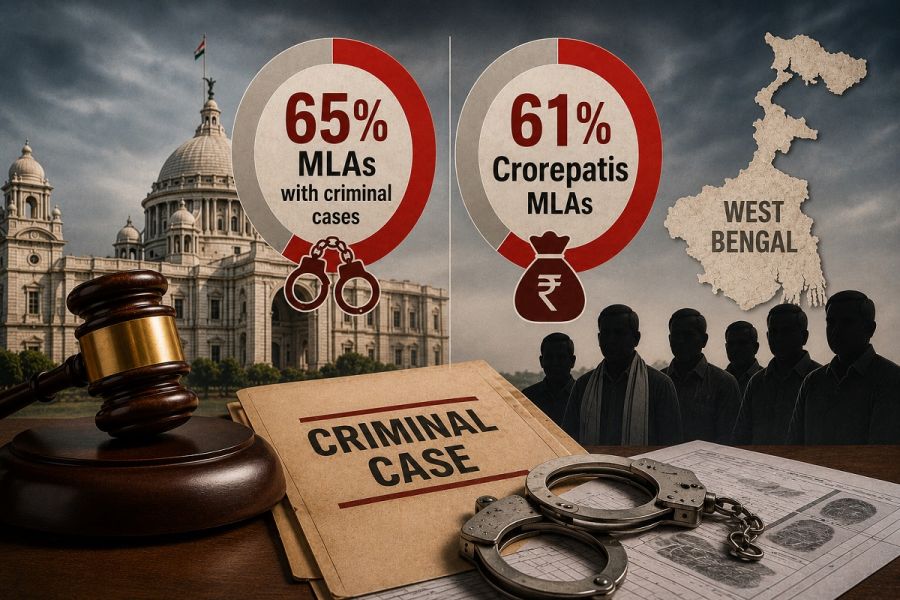
New Delhi - As many as 65 per cent of newly elected legislators in the West Bengal Assembly have declared criminal cases against themselves, marking a sharp rise from the previous election, according to a report by the Association for Democratic Reforms (ADR).
The report, which analysed affidavits of all 292 winning candidates in the 2026 Assembly polls, found that 190 MLAs (65%) have declared criminal cases, up from 142 (49%) in 2021. Of these, 170 legislators (58%) face serious criminal charges, compared to 113 (39%) in the previous Assembly.
Among serious offences, 14 winning candidates have declared cases related to murder (IPC Section 302), while 54 face charges of attempt to murder. Cases related to crimes against women were declared by 63 winners, including two candidates who have disclosed rape charges.
A party-wise analysis showed that 152 of 206 winning candidates (74%) from the Bharatiya Janata Party have declared criminal cases, followed by 34 out of 80 (43%) from the All India Trinamool Congress.
All winning candidates from smaller parties like the Aam Janata Unnayan Party, the Communist Party of India (Marxist), and the All India Secular Front have declared criminal cases. In contrast, both winning candidates from the Indian National Congress have no criminal cases.
The trend is similar for serious criminal cases, with 68 per cent of BJP winners and 31 per cent of Trinamool Congress winners facing such cases.
The ADR report also highlighted the growing wealth among elected representatives. Of the 292 winners, 178 (61%) are crorepatis, up from 54 per cent in 2021. The total declared assets of all winning candidates stand at Rs 1,091 crore, with an average asset of Rs 3.73 crore per MLA, significantly higher than Rs 2.53 crore recorded in the previous Assembly.
Among major parties, the TMC MLAs have average assets of Rs 5.36 crore, followed by BJP legislators at Rs 2.97 crore. The two Congress MLAs reported the highest average assets overall at Rs 17.92 crore.
On educational qualifications, 63 per cent of the winning candidates are graduates or above, while 32 per cent have studied between Class 5 and Class 12. A small number of legislators reported minimal formal education, including one candidate who declared himself illiterate.
The age profile shows that the majority of MLAs (63%) fall in the 41-60 age group, while only 16 per cent are between 25 and 40 years. Around 20 per cent of the legislators are aged between 61 and 80, with three candidates above 80 years.
Women remain underrepresented, with only 37 out of 292 MLAs (13%) being female, a slight decline from 14 per cent in 2021, the report noted.
The ADR report underscored persistent concerns about the criminalisation of politics and the rising concentration of wealth among elected representatives in one of India's key states.
Conversations
The opinions expressed in reader contributions are those of the respective author only, and do not reflect the opinions/views of Trans Asia News.